Embryos Arrest Every IVF Cycle? What the Pattern Means
The first cycle, half the embryos stopped growing and you were told it was normal attrition. Then the second cycle looked almost the same. At that point "bad luck" stops feeling like an explanation, and it should. Two recent studies change how to read that. One, covering 25,974 embryos, found arrest rates vary widely from cycle to cycle, even among women the same age. The other found that people whose embryos all arrested once were about twice as likely to have no blastocysts again in their next cycle. Arrest is partly chance and partly something about the person. That makes your own pattern, read across every cycle you have done, one of the most useful pieces of data you own.
Is it normal for embryos to arrest in every IVF cycle?
Some embryo arrest happens in almost every IVF cycle: in a 2025 study of 25,974 embryos, about 4 in 10 fertilized embryos stopped developing before the blastocyst stage. What is not random is how much arrest a given person sees. People whose embryos all arrested in one cycle were more likely to see heavy arrest again in the next, so a repeated pattern is worth investigating rather than simply retrying.
That is the short answer. The longer one matters more, because the details of these studies change what you should ask your clinic and what you can work on between cycles.
What did the study of 25,974 embryos actually find?
Researchers Alba Reig and Emre Seli analysed 25,974 fertilized embryos from 1,928 IVF cycles and published the results in the journal Aging in 2025 (Reig and Seli, 2025). Three findings stand out:
Arrest is common. Overall, 40.3% of fertilized embryos stopped developing before reaching blastocyst.
Arrest rises with age, but not dramatically. The typical arrest rate was 33% in cycles for women under 35 and 44% for women over 41. Age matters, but plenty of younger patients still lose a large share of their embryos, and plenty of older patients do not.
Arrest and chromosome errors behaved like two separate problems. Both the arrest rate and the aneuploidy (abnormal chromosome) rate of the resulting blastocysts climbed with age. Once the researchers adjusted for age, though, a cycle's arrest rate did not predict how chromosomally normal its blastocysts were.
One honest caveat: the study only included cycles with at least five blastocysts tested by PGT-A, which the authors themselves describe as an extremely good-prognosis group. It tells us less about people who make one or two blastocysts per cycle, and it counted cycles, not individual people. It is strong, large-scale data, but it is not the last word.
If embryos arrest once, will it happen again next cycle?
A separate study from the same research group answered this directly. Published in Fertility and Sterility in 2026, it compared patients whose embryos all arrested in one cycle (no blastocysts at all) with patients who froze at least one blastocyst, then followed both groups into their next IVF cycle, matched for age and egg numbers (George et al., 2026).
In the next cycle, the complete-arrest group turned 33% of fertilized embryos into blastocysts, compared with 47% in the comparison group.
About a third of the complete-arrest group (33.6%) had no blastocysts again, roughly double the comparison group's 17.9%.
Fertilization was slightly lower as well.
The blastocysts that did form were just as likely to be chromosomally normal: about 46% in both groups.
Two things are true at once here. A complete-arrest cycle is a real warning sign that tends to repeat. And about two thirds of those patients did produce at least one blastocyst the next time, so one bad cycle is not a verdict.
If many of my embryos arrest, are my blastocysts more likely to be abnormal?
Not necessarily, and this is the finding most people find surprising. At the level of a single embryo, arrest and chromosome errors are linked: embryos that stall often carry meiotic or mitotic errors (McCoy et al., 2023). But at the level of a whole cycle, both studies above found that a high arrest rate did not mean the surviving blastocysts were more likely to be abnormal once age was accounted for.
A practical way to think about it: arrest decides how many blastocysts you get, and aneuploidy decides how many of those are chromosomally normal. Those are two different levers with two different conversations. If you have PGT-A results, our guide to what euploid, aneuploid and mosaic results mean covers the second lever. This article is about the first.
Why would embryo arrest keep happening to the same person?
Because every embryo starts with what the egg and the sperm bring to it, and those inputs come from the same two bodies cycle after cycle. The research points to several overlapping contributors:
The egg's energy supply. For the first few days the embryo runs almost entirely on the egg's stored mitochondria and machinery. Early arrest leans heavily on egg energetics, which is why our day-by-day guide to embryo arrest starts there.
Sperm DNA integrity. Sperm with fragmented DNA can fertilize normally and look fine on Day 1, then stall once the embryo switches to its own genome around Day 3. A standard semen analysis does not measure this; sperm DNA fragmentation testing does.
The metabolic environment. In lean women without PCOS, insulin resistance was associated with fewer mature eggs and lower blastocyst formation (Wang et al., 2021). This rarely shows up on a fasting glucose alone. More on that in our article on insulin resistance and fertility.
Age. It raises both arrest and aneuploidy, but as the Reig and Seli data show, it explains only part of the variation between people.
Rare genetic causes. In a small number of people, variants in so-called maternal-effect genes such as PADI6, NLRP5 and TLE6 cause embryos to arrest early in cycle after cycle. A 2024 review in Human Reproduction Update catalogues these and other genetic causes of fertilization failure and early arrest (Wei et al., 2024). These are uncommon, and testing for them is a conversation for your reproductive endocrinologist or a genetic counselor, typically after repeated complete early arrest.
Lab and protocol factors. Culture conditions and how a lab handles embryos matter too, and only your clinic can speak to them.
How do you find your own embryo arrest pattern across cycles?
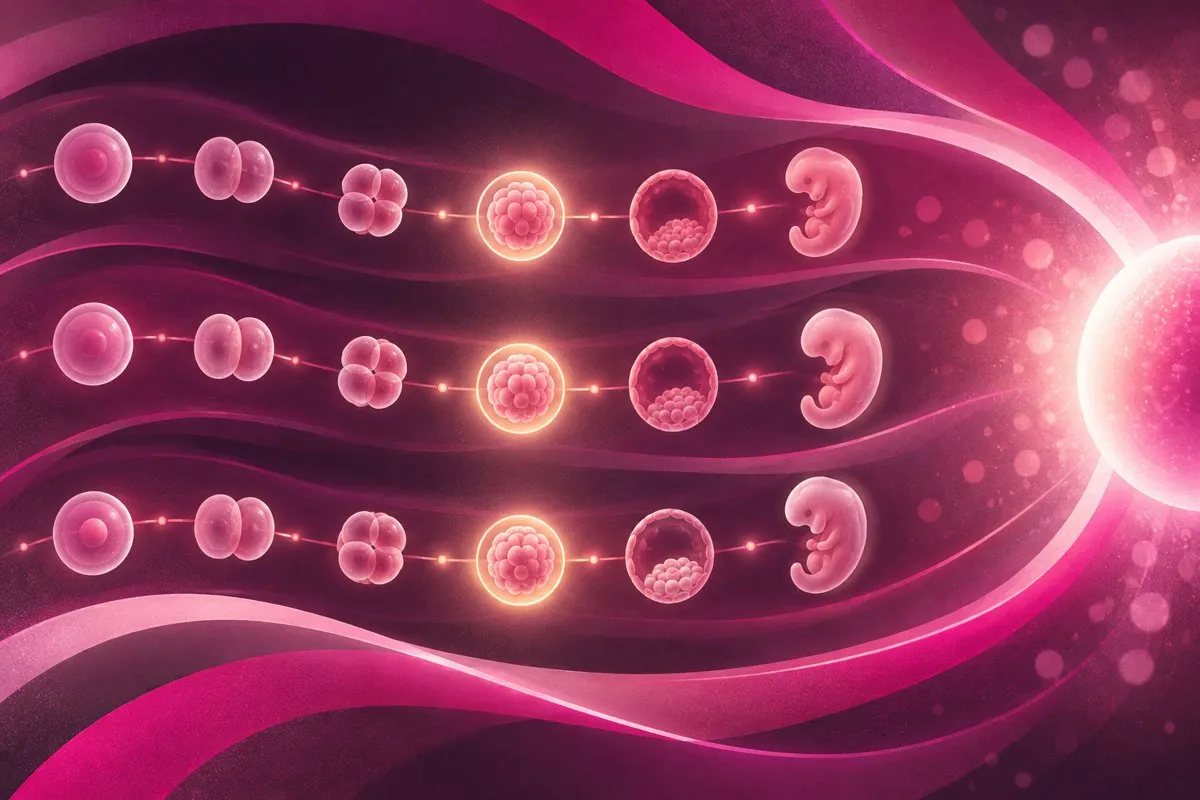
You need the embryo-level report for each cycle, not just the summary phone call. Ask your clinic for the full embryology record. Then, for each cycle, write out the funnel:
Eggs retrieved
Mature eggs (often written MII)
Fertilized normally (2PN)
Still developing on Day 3, with cell counts if listed
Blastocysts on Day 5, 6 or 7
Euploid blastocysts, if you did PGT-A
Now find the single biggest drop in each cycle and note the day it happened. Then lay the cycles side by side. If the biggest loss lands at the same step every time, that is your pattern. Also write down what changed between cycles: the stimulation protocol, the trigger, ICSI versus conventional IVF, the sperm sample, illness, weight, sleep and stress. That list is what turns a frustrating report into something you and your clinic can actually work with.
What can each embryo arrest pattern point to?
These are directions to look, not diagnoses:
Few mature eggs: a stimulation and trigger conversation with your RE, plus the egg's maturation environment.
Mature eggs, poor fertilization: sperm function, fertilization method and egg activation, which belong to your RE and the lab.
Good fertilization, losses on Days 2 to 3: egg energy and oxidative stress. If every embryo stops this early in more than one cycle, ask about a genetic evaluation.
Healthy Day 3, few blastocysts: the genome handoff, sperm DNA integrity and metabolic stress. Our post on low blastocyst conversion goes deeper on this pattern.
Plenty of blastocysts, many aneuploid: the chromosome lever, which is largely age-driven and, per the research above, separate from arrest.
For a checkpoint-by-checkpoint explanation of what each day of development depends on, see embryo arrest by day: what your embryology report says.
Does changing the IVF protocol fix repeated embryo arrest?
Not reliably on its own. In the 2026 Fertility and Sterility study, patients who switched their stimulation protocol or trigger after a complete-arrest cycle did not have better blastocyst rates than patients who kept the same protocol (George et al., 2026). That does not mean protocol never matters for an individual; that decision belongs to your reproductive endocrinologist. It does suggest that changing the medication plan without looking at what the egg and sperm are bringing into the cycle often is not enough.
That is where the time between cycles counts. Eggs complete their final growth over the months before retrieval, and sperm take roughly 74 days to develop, so a structured 90-day plan for both partners reaches the exact cells that will be used. We lay that out on our egg and sperm prep before IVF retrieval page.
What should you ask your clinic after repeated embryo arrest?
Can I have the full embryo-level report for every cycle, including Day 3 cell counts and Day 5 to 7 outcomes?
At which step did we lose the most embryos, and was it the same step each time?
Has my partner had sperm DNA fragmentation testing?
Were my blastocyst euploidy results in line with my age, even though arrest was high?
If every embryo arrested early in more than one cycle, should we see a genetic counselor?
Which metabolic labs, such as fasting insulin, HbA1c and thyroid, were checked before this cycle?
When should Long Island couples get a deeper look before another cycle?
If embryos have arrested heavily in more than one cycle, if a cycle produced no blastocysts at all, or if your partner has never had DNA fragmentation testing, it is worth pausing before paying for another stimulation. Our approach is systems biology fertility care: proven science where it is settled, and your own data where it is not. At our Huntington office we line your embryology funnel up against both partners' labs, covering metabolism, thyroid, inflammation, nutrient status and sperm DNA, and build a time-bound plan that runs alongside your reproductive endocrinologist. Couples come to us from across Nassau and Suffolk County for exactly this review.
If you want a second set of eyes on your reports, start with our IVF support on Long Island, book a Metabolic & Immune Fertility Evaluation, or schedule a free 10-minute call to see whether it is the right next step.
East to West Fertility is a systems biology fertility clinic in Huntington, Long Island, serving patients across Long Island, NYC, and beyond. Learn more about our Metabolic & Immune Fertility Evaluation or call 631-416-4940.
This article is for education and is not medical advice. Decisions about medications, supplements, genetic testing and IVF protocols belong with your reproductive endocrinologist or OB-GYN.
References
Reig A, Seli E. "Developmental arrest rate of an embryo cohort correlates with advancing reproductive age, but not with the aneuploidy rate of the resulting blastocysts in good prognosis patients: a study of 25,974 embryos." Aging, 2025. doi:10.18632/aging.206328
George L, Kalafat E, Sachdev D, Whitehead C, Sahin GN, Werner M, Seli E. "Complete embryo developmental arrest and its prognostic significance in in vitro fertilization." Fertility and Sterility, 2026. doi:10.1016/j.fertnstert.2026.07.005
McCoy RC, Summers MC, McCollin A, et al. "Meiotic and mitotic aneuploidies drive arrest of in vitro fertilized human preimplantation embryos." Genome Medicine, 2023;15(1):77.
Wang H, Zhang Y, Fang X, et al. "Insulin Resistance Adversely Affect IVF Outcomes in Lean Women Without PCOS." Frontiers in Endocrinology, 2021;12:734638.
Wei Y, Wang J, Qu R, et al. "Genetic mechanisms of fertilization failure and early embryonic arrest: a comprehensive review." Human Reproduction Update, 2024;30(1):48-80.