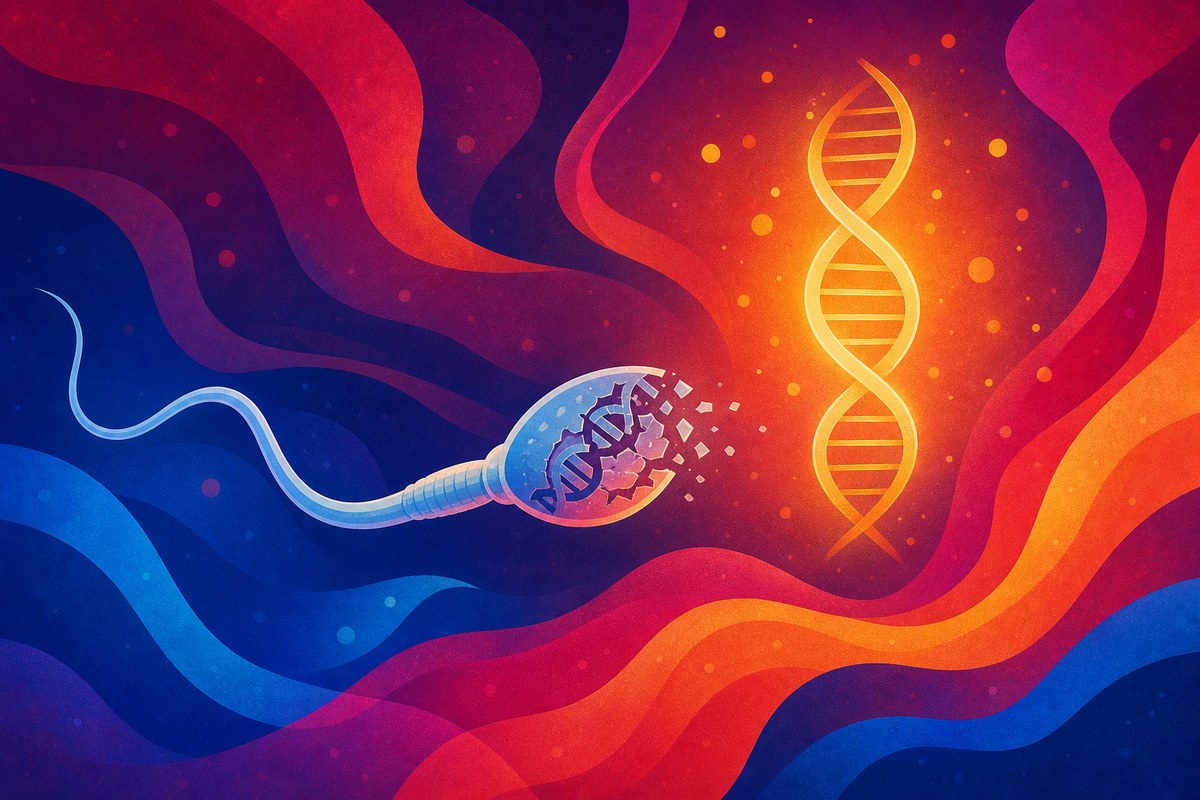
Sperm DNA Fragmentation: The Test a Semen Analysis Misses
Can Sperm DNA Fragmentation Be High If My Semen Analysis Is Normal?
Yes. A semen analysis measures how many sperm are present and whether they move and look reasonably typical. It does not measure whether the DNA inside those sperm is intact. A man can have a report labelled normal and still carry a high level of sperm DNA damage, which is why couples with unexplained infertility, poor embryo development, or recurrent pregnancy loss are sometimes told everything looks fine when it does not fully explain what they are living through.
A semen analysis can come back "normal" while sperm fragmentation is still high. For couples facing unexplained infertility, poor embryo development, failed IVF transfer, or recurrent pregnancy loss, that gap matters. A sperm count tells us how many sperm are present and whether they move and look reasonably typical. It does not necessarily tell us whether the DNA inside those sperm is intact enough to reliably support fertilization, embryo development, and a healthy pregnancy.
This is where we stop accepting "everything looks fine" as a complete answer. Sperm DNA integrity is one part of a larger reproductive picture, but it can be a clinically meaningful missing piece - particularly when the female partner has already endured extensive testing and treatment without a clear explanation.
What Is Sperm Fragmentation?
Sperm fragmentation refers to breaks or damage within the DNA carried by sperm. Each sperm delivers half of the genetic material needed to create an embryo. When DNA is damaged, fertilization may still occur, especially with ICSI, but the embryo may have a harder time developing normally as it reaches later stages.
The body has some capacity to repair sperm DNA damage after fertilization. Egg quality matters here. A younger, healthier egg may be better equipped to repair limited damage, while age-related changes in egg mitochondrial function can reduce that repair capacity. This is one reason the same male-factor pattern may have very different consequences for different couples.
A DNA fragmentation index, or DFI, estimates the percentage of sperm with detectable DNA damage. Different laboratories use different testing methods and reference ranges, so one number should never be interpreted in isolation. Still, a higher DFI can help explain patterns that a standard semen analysis misses, including low blastocyst rates, repeated failed cycles, or pregnancy losses after apparently successful fertilization.
Why a Standard Semen Analysis Is Not Enough
A conventional semen analysis typically evaluates semen volume, concentration, motility, morphology, and sometimes signs of inflammation. These are valuable baseline measures. They are not useless or obsolete. But they are a surface-level assessment of sperm production and transport, not a complete audit of sperm function.
A man can have strong concentration and motility yet still have elevated DNA fragmentation. Conversely, a low sperm count does not automatically mean high fragmentation. These measurements overlap, but they are not interchangeable.
For couples who have been told to keep trying because routine results look acceptable, advanced sperm testing can shift the conversation from assumptions to evidence. At East to West Fertility, this means reviewing the standard semen analysis alongside advanced DFI and oxidative stress assessment, medical history, metabolic markers, inflammatory patterns, exposures, and the couple's actual fertility outcomes. The goal is not to chase one isolated number. It is to identify the biological conditions affecting sperm quality.
Oxidative Stress Is Often Part of the Story
Oxidative stress occurs when reactive oxygen species outpace the body's antioxidant defenses. Sperm are especially vulnerable because their cell membranes contain high levels of fatty acids and their DNA packaging offers limited protection compared with many other cells.
Oxidative stress can damage the sperm membrane, reduce motility, and contribute to DNA fragmentation. Advanced oxidative stress assays may help clarify whether this mechanism is likely active. That matters because a treatment plan focused only on "fertility supplements" without identifying the source of oxidative stress can become expensive guesswork.
Mitochondria are central to this discussion. They generate the energy sperm need for movement, but dysfunctional mitochondria can also contribute to excess oxidative stress. Supporting sperm mitochondrial health is therefore not a cosmetic add-on to a fertility plan. For the right patient, it is a targeted strategy aimed at the cellular environment in which sperm are produced and mature.
Common Drivers of Elevated Sperm DNA Damage
There is rarely one explanation. Sperm fragmentation can reflect a combination of anatomy, inflammation, metabolism, environment, and timing. A strategic evaluation looks for the drivers that are both medically relevant and modifiable.
Varicocele, an enlargement of veins around the testicle, is one common consideration. It may raise testicular temperature and oxidative stress, affecting sperm production and DNA integrity. A reproductive urologist should evaluate suspected varicocele, especially when DFI is elevated or semen parameters are abnormal.
Recent fever, COVID-19, influenza, or another significant illness can temporarily affect sperm quality. Because sperm production takes roughly 74 days, followed by additional maturation time, a test performed soon after illness may not represent a man's usual baseline. Retesting at an appropriate interval can be more informative than panicking over a single result.
Other contributors can include smoking or vaping, heavy alcohol use, cannabis use, heat exposure from hot tubs or frequent sauna use, poor sleep, intense untreated stress, obesity, insulin resistance, nutrient deficiencies, environmental exposures, chronic inflammation, and genital tract infection. Certain medications and testosterone therapy can also impair sperm production. None of these factors should be assumed without a medical review, but none should be dismissed because a couple is pursuing IVF.
Abstinence time can influence results as well. Longer periods without ejaculation may increase semen volume and sperm count, yet in some men they may also be associated with more oxidative damage. Collection instructions matter, and repeat testing should be performed under comparable conditions whenever possible.
When to Consider Advanced Sperm Testing
Not every couple needs a DFI test at the beginning of trying to conceive. It becomes especially useful when the clinical picture suggests that standard testing has not captured the full story.
Consider a deeper sperm evaluation when there is unexplained infertility after six months or longer of trying in the setting of age-related fertility pressure, recurrent miscarriage, poor blastocyst development, repeated IVF or ICSI failure, low fertilization, known varicocele, abnormal semen parameters, or a history of significant illness and metabolic concerns. It can also be reasonable when there is male-factor concern but no clear explanation for why conception has not occurred.
The test does not diagnose every cause of infertility, and it cannot predict the outcome of one individual cycle with certainty. It is a decision-support tool. Its value depends on whether the result will change the next clinical step. In our Huntington practice, that is the filter we apply before ordering it: we want to know in advance what a high or low result would change.
Sperm results are one part of a wider panel — see how to interpret fertility labs beyond a normal result for how they are read alongside hormone, thyroid and metabolic markers.
What a Targeted Plan Can Look Like
A high DFI result should lead to a structured conversation, not shame or a generic instruction to "take antioxidants." Male-factor infertility is common, and sperm quality is not a measure of masculinity, effort, or whether someone has done anything wrong.
The first step is to confirm context. Was the sample collected after a recent fever? Was abstinence unusually long? Is there a varicocele, infection risk, medication issue, or metabolic pattern that warrants referral or treatment? A reproductive urologist may be essential when a correctable anatomical or medical cause is suspected.
From there, a plan may include addressing sleep, blood sugar regulation, body composition, inflammation, heat exposure, and targeted nutrient insufficiencies. It may also include a clinician-designed sperm mitochondrial support protocol, antioxidant strategy, and custom herbal support when appropriate. These interventions should be coordinated with the couple's fertility physician, particularly if an IVF retrieval or transfer timeline is approaching.
Timing is non-negotiable. Meaningful changes in sperm quality usually require at least one full sperm-production cycle, often around three months. This can feel frustrating when age or treatment deadlines are pressing. Yet proceeding without addressing a significant male-factor pattern may simply repeat the same biological conditions in the next cycle.
There are situations where assisted reproductive technologies are still the most practical next step. ICSI can help overcome certain fertilization barriers, and surgical sperm retrieval may be discussed in select cases of persistently high fragmentation. But technology works best when it is paired with a serious effort to understand the physiology behind the result. The right path depends on female age, ovarian reserve, embryo history, DFI level, male medical findings, and the couple's timeline.
How Does Oxidative Stress Change the Treatment Plan?
This is where DNA fragmentation stops being a number and starts being a decision. Oxidative stress is not one condition with one fix. It is an imbalance between the reactive oxygen species a man's biology produces and the antioxidant capacity available to neutralize them, and where that imbalance is coming from changes what actually needs treating.
Where the Damage Happens Points to Different Treatment
Sperm DNA can be damaged during production in the testes, during maturation and storage in the epididymis, or after ejaculation during processing. These are not interchangeable problems.
When fragmentation appears to be accumulating during storage and transit, the useful conversations are often about a shorter abstinence interval before collection or repeat testing under different conditions, along with reproductive urology input. When the pattern points to production itself, the work sits upstream in metabolic and vascular health: glycemic regulation, insulin sensitivity, body composition, inflammatory load, sleep and circadian rhythm, scrotal heat exposure, nicotine and alcohol, and nutrient status. When a varicocele, infection, or medication effect is in the picture, that is a urologic question first and a metabolic one second.
A generic antioxidant recommendation treats all three of these as the same problem. They are not, and that is the difference between a plan and a supplement list.
Mitochondrial Support Runs Alongside IUI, IVF, and ICSI, Not Instead of It
The sperm midpiece is dense with mitochondria, which power motility and are themselves a source of reactive oxygen species. That gives mitochondrial function a dual role in male fertility: it drives the movement the sperm needs, and it contributes to the oxidative environment the DNA sits in. Supporting that machinery is not an alternative to assisted reproduction. It is preparation for it.
This matters most for the treatments many couples assume have already solved the problem. IUI relies on the sperm's own capacity to reach and fertilize the egg. Conventional IVF still involves a degree of natural selection in the dish. ICSI bypasses that selection entirely by injecting a single chosen sperm, which is precisely why DNA integrity remains relevant even when fertilization is no longer the barrier. Fertilization can succeed while embryo development, blastocyst progression, or implantation still reflect what the sperm brought with it.
Practically, this means sequencing. A clinician-designed antioxidant and mitochondrial support plan is most useful when it begins far enough ahead of a retrieval or insemination to cover a full sperm-production cycle, and when the fertility physician knows exactly what is being taken. Some laboratory protocols and medications interact with supplement timing, and more antioxidant is not automatically better. Overshooting can push the balance in the other direction, a state described as reductive stress, which is one more reason this belongs in a coordinated plan rather than a self-directed one.
What Varies Between Two Men With the Same DFI Result
Two men can return a similar fragmentation result and need very different care. One with insulin resistance, disrupted sleep, and high inflammatory markers has a metabolic problem expressing itself in sperm. One with an untreated varicocele has a vascular and thermal problem. One with a recent febrile illness may simply need retesting after a full production cycle before anyone concludes anything. And where fragmentation stays elevated despite genuine effort, the discussion may shift toward laboratory and surgical strategies for sperm selection, decided by the reproductive endocrinologist and urologist.
The DFI number opens the question. The metabolic, vascular, and medical context answers it, and that context is what determines whether the next cycle is a repeat of the last one.
A Better Question Than "Is the Semen Analysis Normal?"
The more useful question is: does the sperm assessment explain the outcome this couple is having, and does it point to an actionable next step? Fertility care is strongest when egg health, sperm health, uterine conditions, hormones, metabolism, immune signaling, and embryo development are evaluated as connected systems rather than separate boxes.
If sperm fragmentation is elevated, there may be a clear opportunity to improve the conditions shaping sperm DNA integrity before the next attempt. If it is not elevated, that information is useful too. It allows the investigation to move forward instead of circling back to a male factor that has not been properly assessed.
You deserve an evaluation that treats a normal-looking report as the beginning of the question, not the end of it. We work through this with couples across Long Island and the New York metro area, and our male factor fertility care looks at sperm DNA integrity alongside the metabolic and inflammatory conditions producing it.
This article is for general educational purposes and isn't a substitute for individualized guidance from your urologist, OB-GYN, or fertility specialist. Decisions about testing, medication, supplements, or surgery should be made with your own care team.
East to West Fertility is a metabolic and immune-focused fertility clinic in Huntington, Long Island, serving patients across Long Island, NYC, and beyond. Learn more about our Metabolic & Immune Fertility Evaluation or call 631-416-4940.