Embryo Arrest by Day: What Your Embryology Report Says
The embryology update usually arrives in pieces. Day 1: how many fertilized. Day 3: how many are still dividing. Day 5 or 6: how many made it to blastocyst, or the call nobody wants, that none did. Most people are told the drop-off is normal attrition and that the next cycle is a fresh roll of the dice. Part of that is true. But the day an embryo stops is not random information, and when people read their embryology report checkpoint by checkpoint, it often points to which system deserves attention in the 90 days before the next retrieval.
Why do embryos stop growing, and does the day they stop matter?
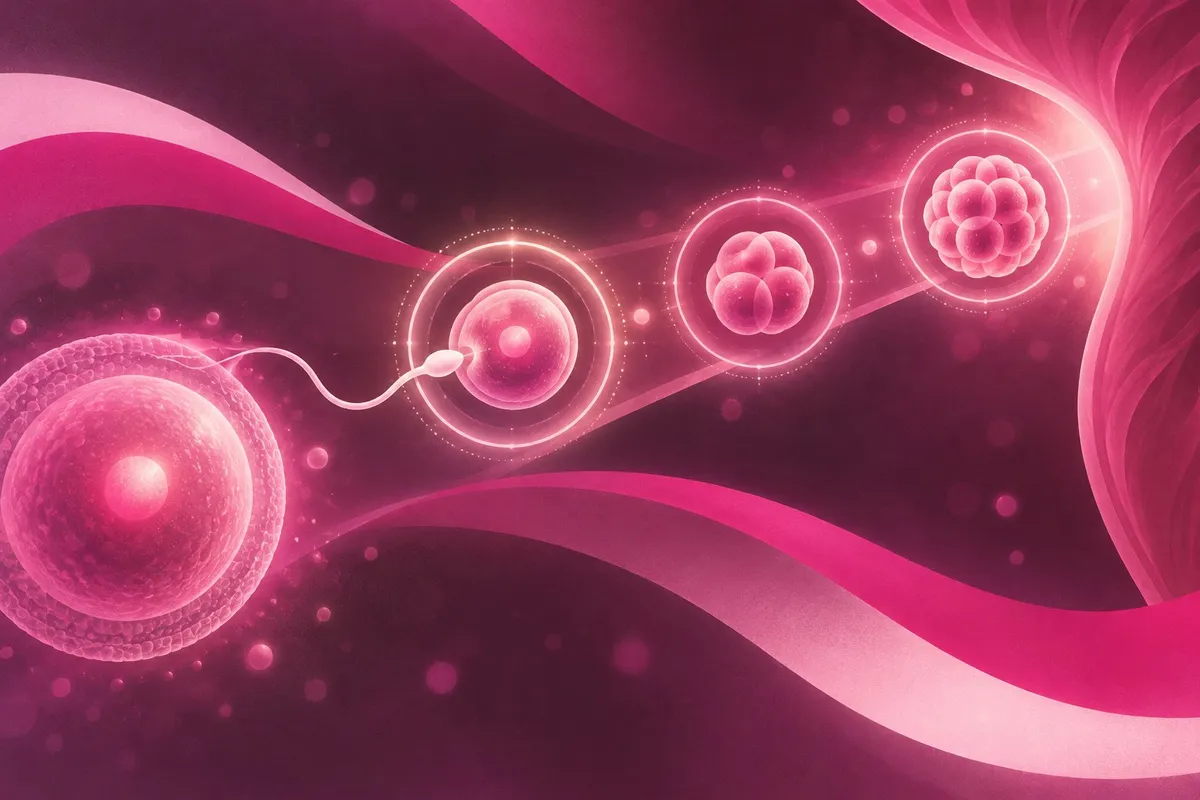
Embryos stop growing (embryo arrest) when a developmental checkpoint fails: fertilization on Day 1, early cell division on Days 2 to 3, the switch to the embryo's own genes around the 4 to 8 cell stage, and blastocyst formation on Days 5 to 6. Each checkpoint leans on a different system, the egg's energy supply early on, sperm DNA and the genome handoff in the middle, and chromosomes plus metabolic stress late, so the day of arrest is a useful clue about what to support before the next cycle.
That does not mean every arrested embryo has a fixable cause. In a systematic review of the molecular drivers of developmental arrest, the authors note that only around half of normally fertilized embryos reach blastocyst in the lab, and a large share of that loss is chromosomal (Sfakianoudis et al., 2021). Arrest is common. The useful question is whether a pattern shows up across a cycle, or across two, that points somewhere specific.
What does it mean when embryos stop on Day 2 or Day 3?
For roughly the first three days, the embryo is running almost entirely on the egg's stored machinery: the proteins, messenger RNA and mitochondria packed into it during its final months of growth. The embryo's own genes are not meaningfully switched on yet, and it does not build new mitochondria until much later. So slow cleavage, heavy fragmentation, uneven cell sizes or arrest before Day 3 tend to reflect the quality of that starting inventory.
Mitochondria are central here. Reviews of oocyte energetics link poor mitochondrial function to spindle errors, fragmentation and early arrest (Van Blerkom, 2011), and time-lapse work has shown that the timing of the first few divisions, before the embryo's genome takes over, predicts which embryos go on to form blastocysts (Wong et al., 2010). That is why early-arrest patterns usually send us back to the egg: oxidative stress, blood sugar swings, thyroid and nutrient status, and the overall metabolic environment the follicle grew in.
Supplement research here is still early. Coenzyme Q10 and related mitochondrial nutrients have shown benefit in animal models and in small studies of poor responders, but larger randomized trials have not settled the question. That is a reason to test and track rather than guess, and to clear any supplement plan with the reproductive endocrinologist running your cycle. Our deeper look at which mitochondrial supplements have real egg-quality data covers the evidence nutrient by nutrient.
What happens on Day 3, and why does sperm quality start to show up there?
Around the 4 to 8 cell stage, the embryo flips the switch. It stops relying only on the egg's stored instructions and starts reading its own combined genome. Braude and colleagues first showed in 1988 that human embryonic gene expression begins between the four- and eight-cell stages, and failure of that activation is one of the recognized molecular causes of cleavage arrest (Sfakianoudis et al., 2021).
This handoff is also where the father's contribution starts to count. A sperm with fragmented DNA can still fertilize an egg and look perfectly normal on Day 1, because early development runs on the egg's repair capacity. Once the embryo depends on its own genome, unrepaired paternal DNA damage can surface as slowed development and poorer blastocyst formation (Simon et al., 2014). A standard semen analysis does not measure this. Sperm DNA fragmentation testing does, and it is one of the most commonly skipped tests in couples whose embryos keep stalling around Day 3. If a partner has only had a count-and-motility report, our guide to semen analysis versus sperm DNA fragmentation explains what each one can and cannot see.
The good news is timing. Sperm take roughly 74 days to develop (Heller and Clermont, 1963), so a partner who starts a structured plan three months before retrieval is supporting the exact sperm that will be used.
Made it to Day 3, then stalled before blastocyst: what does that point to?
Embryos that keep dividing past Day 3 but never compact or form a blastocyst on Days 4 to 6 often carry chromosomal errors. A 2023 study in Genome Medicine found that both meiotic errors (from the egg) and mitotic errors (arising after fertilization) drive arrest as embryos come to rely on their own gene expression (McCoy et al., 2023). Nobody can rewrite an egg's chromosomes, and age is the strongest driver of meiotic error.
One nuance from newer data: across a whole cycle, how many embryos arrest and how many blastocysts turn out chromosomally abnormal behave like two separate problems. In a 2025 study of 25,974 embryos, both rose with age, but once age was accounted for, a cycle's arrest rate did not predict the aneuploidy rate of its blastocysts (Reig and Seli, 2025). A high arrest rate does not, on its own, mean the blastocysts you do get are more likely to be abnormal.
Metabolic stress is the more modifiable piece. In a study of lean women without PCOS, those with insulin resistance had a lower mature egg rate and lower blastocyst formation than lean women without it (Wang et al., 2021). That matters because lean insulin resistance is rarely screened for. A fasting glucose can look normal for years while fasting insulin is already climbing. When we see a Day 4 to 6 stall pattern, insulin resistance, inflammation and nutrient status are on the list to check, along with an honest conversation with the IVF lab about culture conditions and stimulation protocol.
How do you read your embryology report as a map?
Ask your clinic for the full embryology report, not just the summary call. Then line the numbers up by day:
Day 1, fertilization: how many mature eggs fertilized normally (two pronuclei). Low fertilization raises questions about egg maturity, sperm function and the fertilization method used.
Days 2 to 3, cleavage: cell number, fragmentation and evenness. Most of the drop-off here leans toward egg energy and oxidative stress.
Day 3 to 4, the genome handoff: embryos that stop right around the 4 to 8 cell stage put sperm DNA integrity and embryonic gene activation on the table.
Days 5 to 6, blastocyst: stalls here lean toward chromosomes and metabolic stress, and are worth comparing against PGT-A results if you have them. Our explainer on what euploid, aneuploid and mosaic results mean walks through that layer.
One cycle is a small sample. Two cycles with the same pattern is a signal. Either way, the report tells you where to look first, which is far more useful than starting the next stimulation with nothing changed.
That signal is backed by research. In a 2026 Fertility and Sterility study, patients whose embryos all arrested in one cycle were about twice as likely to have no blastocysts in their next cycle, and switching the stimulation protocol or trigger did not change that (George et al., 2026). How to compare cycles side by side, and what each repeated pattern can point to, is covered in why embryos arrest every IVF cycle and what the pattern means.
What can couples actually change before the next retrieval?
You cannot change every chromosome. You can change the environment both sets of cells mature in, and both partners are part of that. In the roughly three months before retrieval, the levers with the most support are:
Egg energy and oxidative load: blood sugar stability, sleep, antioxidant-rich food, and a mitochondrial nutrient plan reviewed with your RE.
Metabolic screening, even if you are lean: fasting insulin and glucose, HbA1c, thyroid function and key nutrients such as vitamin D and iron.
Inflammation: gut health, sleep and cycle-tracked markers rather than guesswork.
The partner's 74-day window: sperm DNA fragmentation testing, heat and alcohol exposure, and a structured three-month sperm prep plan.
Circulation and stress load: where acupuncture fits as one supporting tool alongside the medical plan, not a replacement for it.
We put all of this together on one page: egg and sperm prep before IVF retrieval, a 90-day plan for both partners built around your embryology report and your labs.
When should couples on Long Island look deeper before another cycle?
When embryos have arrested at the same checkpoint more than once, when a cycle produced good fertilization but no blastocysts, or when the male partner has never had DNA fragmentation testing, it is worth pausing before paying for another stimulation. At our Huntington office we start with a systems-level workup that looks at metabolism, thyroid, inflammation, immune and clotting factors and both partners' results, then turn the embryology report into a time-bound plan that runs alongside your reproductive endocrinologist. Patients come to us from across Nassau and Suffolk County for exactly this review. If you want a second set of eyes on your report, start with our IVF support on Long Island or book a Metabolic & Immune Fertility Evaluation.
Save this before your next cycle, and bring your embryology report to the next conversation with your RE.
East to West Fertility is a systems biology fertility clinic in Huntington, Long Island, serving patients across Long Island, NYC, and beyond. Learn more about our Metabolic & Immune Fertility Evaluation or call 631-416-4940.
This article is for education and is not medical advice. Decisions about medications, supplements and IVF protocols belong with your reproductive endocrinologist or OB-GYN.
References
Sfakianoudis K, Maziotis E, Karantzali E, et al. "Molecular Drivers of Developmental Arrest in the Human Preimplantation Embryo: A Systematic Review and Critical Analysis Leading to Mapping Future Research." International Journal of Molecular Sciences, 2021;22(15):8353.
Van Blerkom J. "Mitochondrial function in the human oocyte and embryo and their role in developmental competence." Mitochondrion, 2011;11(5):797-813.
Wong CC, Loewke KE, Bossert NL, et al. "Non-invasive imaging of human embryos before embryonic genome activation predicts development to the blastocyst stage." Nature Biotechnology, 2010;28(10):1115-1121.
Braude P, Bolton V, Moore S. "Human gene expression first occurs between the four- and eight-cell stages of preimplantation development." Nature, 1988;332(6163):459-461.
Simon L, Murphy K, Shamsi MB, et al. "Paternal influence of sperm DNA integrity on early embryonic development." Human Reproduction, 2014;29(11):2402-2412.
Heller CG, Clermont Y. "Spermatogenesis in man: an estimate of its duration." Science, 1963;140(3563):184-186.
McCoy RC, Summers MC, McCollin A, et al. "Meiotic and mitotic aneuploidies drive arrest of in vitro fertilized human preimplantation embryos." Genome Medicine, 2023;15(1):77.
Wang H, Zhang Y, Fang X, et al. "Insulin Resistance Adversely Affect IVF Outcomes in Lean Women Without PCOS." Frontiers in Endocrinology, 2021;12:734638.
Reig A, Seli E. "Developmental arrest rate of an embryo cohort correlates with advancing reproductive age, but not with the aneuploidy rate of the resulting blastocysts in good prognosis patients: a study of 25,974 embryos." Aging, 2025. doi:10.18632/aging.206328
George L, Kalafat E, Sachdev D, et al. "Complete embryo developmental arrest and its prognostic significance in in vitro fertilization." Fertility and Sterility, 2026. doi:10.1016/j.fertnstert.2026.07.005