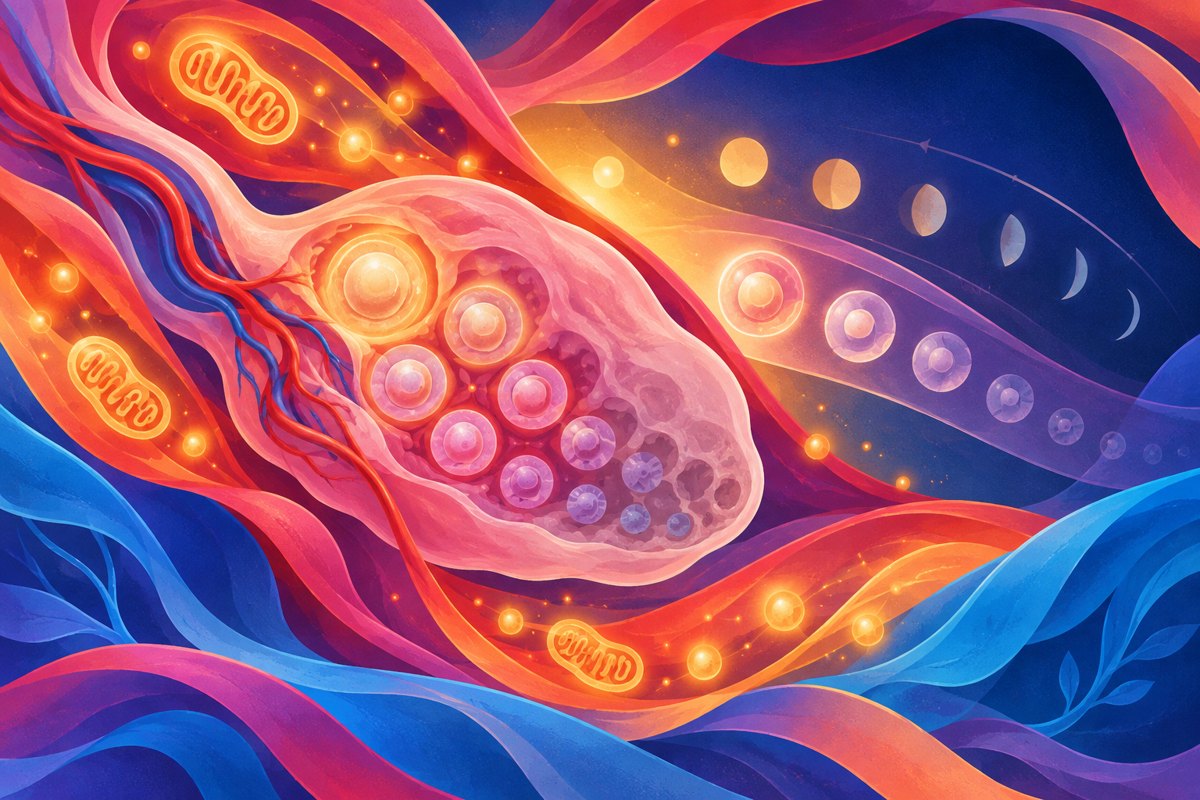
What Causes Low Egg Reserve, and What You Can Influence
A low AMH result can change the emotional temperature of a fertility journey in a single phone call. If you have been trying, tracking, preparing for IUI or IVF, or recovering from a loss, the question is rarely just what the number means. It is what causes low egg reserve, and whether anything about it can still be influenced.
What causes low egg reserve?
Low egg reserve is driven mostly by biology over time — the follicle pool you were born with, the rate at which it is used up, and events that accelerate that loss. The established causes are age-related follicle decline, genetic patterns such as an FMR1 premutation or a family history of early menopause, ovarian surgery and endometriomas, chemotherapy or pelvic radiation, and certain autoimmune conditions, with smoking and some chemical exposures shortening the timeline. It is almost never one choice you made or failed to make, and a low result is a reason to look more closely at ovarian function, egg quality and the rest of the fertility picture rather than the end of the investigation.
What does "low ovarian reserve" actually measure?
Ovarian reserve is an estimate of the remaining supply of eggs. It is assessed with anti-Müllerian hormone (AMH), an antral follicle count (AFC) on ultrasound, and sometimes early-cycle follicle-stimulating hormone (FSH) and estradiol. Those markers are genuinely useful, and they are also narrower than most patients are told.
The American Society for Reproductive Medicine's committee opinion on ovarian reserve testing is blunt about the boundary: these tests predict how ovaries are likely to respond to stimulation, not whether you can conceive. In one prospective study of 750 women aged 30 to 44 with no history of infertility, neither low AMH nor elevated FSH was associated with a reduced chance of conceiving within six or twelve cycles. Reserve markers do not measure egg quality, fertilization, embryo development, implantation, the sperm contribution or the ability to carry a pregnancy. If your numbers are confusing on their own, our breakdown of what AMH and antral follicle count each measure and of low AMH with a high FSH and normal cycles covers that distinction in detail.
How much of low egg reserve is simply age?
Age is the most common reason reserve declines. You are born with a finite number of immature follicles, that pool falls throughout life, and modelling of human ovarian reserve from conception to menopause shows the decline steepening in the mid-to-late thirties rather than proceeding at one steady rate.
Age also affects egg quality, which is a separate axis. In a review of 15,169 consecutively biopsied blastocysts, the chance of having no chromosomally normal embryo in a cohort sat between two and six percent for women aged 26 to 37, rose to roughly a third at 42, and to about half at 44. That is why two patients with the same AMH can have very different outcomes: reserve speaks to quantity, while age and ovarian cellular function shape quality.
Can genetics explain an early drop in ovarian reserve?
Yes, and it is under-asked. Some women start with a smaller follicle pool or decline earlier for genetic reasons. A family history of early menopause or primary ovarian insufficiency, an FMR1 (fragile X) premutation, or certain chromosomal conditions all deserve attention — carriers in the premutation range have measurably higher rates of ovarian dysfunction and earlier menopause.
Genetics are not always obvious from the outside. If your mother, sisters or close relatives went through menopause early, say so during your evaluation. It does not predict the same outcome for you, but it changes the urgency and the scope of testing. European guidance on primary ovarian insufficiency recommends genetic assessment, including FMR1 testing, when ovarian function fails before 40.
Does ovarian surgery or endometriosis lower egg reserve?
Ovarian cystectomy, especially for endometriomas, can reduce reserve, because healthy ovarian tissue is difficult to separate from the cyst wall. A meta-analysis of eight prospective cohorts found a significant fall in AMH after endometrioma excision. That does not make the surgery wrong — large, painful, suspicious or obstructive cysts may need treating — but it means surgical planning should account for future fertility whenever there is time to plan.
Endometriosis also appears to affect the ovary without a scalpel involved. In a prospective study of forty women with untreated endometriomas and forty age-matched controls, median AMH fell about 26 percent over six months in the endometrioma group versus about 7 percent in controls. Chronic pelvic inflammation, oxidative stress in the cyst environment, altered immune signalling and local blood-flow changes are the mechanisms under investigation. A "normal" pelvic ultrasound does not rule the disease out — as we cover in severe endometriosis without obvious pain, imaging misses a great deal. Severe period pain, pain with intercourse, bowel or bladder symptoms around menstruation, or unexplained infertility all warrant a fuller conversation, and our PCOS and endometriosis care page explains how we work through it.
Can cancer treatment or autoimmune disease reduce ovarian reserve?
Chemotherapy, radiation near the pelvis and some immune-suppressing treatments can damage follicles or accelerate their loss. How much depends on the drug class, the cumulative dose, age at treatment and whether the ovaries sat inside the radiation field. ASCO's clinical practice guideline is explicit that anyone facing potentially gonadotoxic treatment should be offered fertility preservation counselling as early as possible, and referred to a specialist when they are interested. For survivors, it is still worth assessing current ovarian function rather than assuming fertility is either untouched or gone.
Autoimmune disease is a real but narrower contributor. Autoimmune mechanisms are estimated to account for a minority of primary ovarian insufficiency cases, most clearly where adrenal or other endocrine tissue is involved. Thyroid autoimmunity, adrenal autoimmunity, celiac disease and lupus can all be relevant depending on your symptoms and history — we walk through the evidence in autoimmune disease and AMH. This is not an argument for blanket testing. Targeted investigation works better: menstrual changes, thyroid patterns, gastrointestinal symptoms, skin changes, fatigue, recurrent loss, inflammatory pain, medication history and the direction your prior labs have moved.
Do smoking and chemical exposures affect ovarian reserve?
Smoking is consistently linked to earlier ovarian ageing. In the Women's Health Initiative Observational Study, which included 93,676 postmenopausal women, women who had ever smoked had higher odds of both infertility and menopause before 50 than women who never smoked. Stopping still matters for fertility, pregnancy and general health, but the exposure that already happened is part of your timeline.
Environmental exposure deserves the same practical treatment. NHANES analyses have associated higher body burdens of several persistent organic pollutants and phthalates with earlier menopause, and occupational contact with solvents and pesticides belongs in your history. None of this is about assigning blame. Exposure history helps identify what is still modifiable and informs decisions about timing and treatment.
What does not automatically explain a low AMH result?
Stress is the most common misattribution. It affects sleep, appetite, sexual health, cycle regularity and your capacity to get through treatment, and it is not a sufficient explanation for diminished reserve. Being thin, being heavier, having PCOS or using birth control does not automatically explain a low result either.
Two technical points matter here. Combined hormonal contraception suppresses AMH: in a randomised comparison of oral, transdermal and vaginal combined contraceptives, AMH fell significantly across all three routes after nine weeks of continuous use, so a result drawn on the pill can read falsely low. And PCOS usually produces a higher AFC and AMH — serum AMH runs markedly elevated in PCOS because of the follicle excess — although PCOS and low reserve can coexist. AMH also varies biologically within a cycle: in 259 regularly cycling women sampled at up to eight points per cycle, levels shifted measurably across the cycle. One value is a data point, not a diagnosis. If a result does not match your age, cycle history or ultrasound findings, it should be repeated and read alongside the trend in your other labs rather than accepted in isolation.
Is low egg reserve the same as poor egg quality?
No, and conflating the two causes a lot of unnecessary despair. Reserve estimates the follicle pool available. Egg quality describes an egg's ability to mature, fertilise, support normal embryo development and contribute to a healthy pregnancy. That is why some patients with low AMH produce good embryos, and why others with reassuring numbers hit a wall at low blastocyst conversion.
Quality tracks with age, and it also runs through mitochondrial function. Mitochondria supply the energy an egg needs for maturation, chromosome organisation, fertilisation and early embryo division, and reviews of ovarian ageing place mitochondrial decline near the centre of that process. Metabolic dysfunction, chronic inflammation, oxidative stress, nutrient deficiencies, disrupted sleep and poor circulation all add load to that same energy system — which is where the mitochondrial side of egg quality and the practical work of supporting egg quality come in.
Be careful with the claims in this space. No supplement, acupuncture protocol or lifestyle plan creates new eggs, and nothing makes a chromosomally normal embryo a settled outcome — treat anything promising to "restore" your ovarian reserve with suspicion. What can reasonably be pursued is improving the conditions around ovarian function, which matters most when time is short.
What should a real evaluation look at beyond AMH?
If you have been told your reserve is low, the next step is not to repeat AMH and hope for a friendlier number. A useful evaluation asks what is happening across the whole system and what can be acted on over the next three, six and twelve months.
That means reviewing AMH, AFC, FSH and estradiol together, cycle length and confirmed ovulation, thyroid and metabolic markers, iron and nutrient status, inflammatory and immune clues, pelvic imaging, endometriosis risk, medication and surgical history, and prior IVF response. If you are trying with a male partner, sperm belongs in the same conversation: a standard semen analysis can miss DNA fragmentation and other functional problems that show up only after fertilisation, which is what our male-factor workup is built to find.
At East to West Fertility in Huntington, that investigation is organised into a Personalized 90-Day Fertility Roadmap. The goal is not to replace your OB-GYN or reproductive endocrinologist. It is to hand every specialist involved a clearer, more operational picture of the biological factors that may be influencing your outcome.
When should you move quickly?
A low reserve finding calls for timely decisions, particularly after 35, after repeated unsuccessful treatment, or when AMH and AFC are both low. Timely is not panicked. It means getting a realistic conversation about natural conception, IVF, egg or embryo freezing where appropriate, and the biological factors that can be worked on alongside treatment.
Seek prompt reproductive endocrinology input if your periods are very irregular or absent, if you have signs of early menopause, if you have a history of chemotherapy or ovarian surgery, or if you have had repeated IVF cycles with a low egg yield. If your cycles are regular and your AMH is low, do not assume pregnancy is off the table — ask for an interpretation that includes your full history and your ultrasound findings. Patients across Long Island come to us at exactly that point, with one number and no plan.
A low egg reserve result is information, not a verdict. The most useful next move is to replace broad reassurance and isolated lab values with a plan that respects both the biology of time and the factors still worth improving.
This article is for general educational purposes and is not a substitute for individualized medical care. Testing, diagnosis, genetic screening and any medication decisions belong with your OB-GYN or reproductive endocrinologist, based on your own history.
East to West Fertility is a metabolic and immune-focused fertility clinic in Huntington, Long Island, serving patients across Long Island, NYC, and beyond. Learn more about our Metabolic & Immune Fertility Evaluation or call 631-416-4940.
References:
- Practice Committee of the American Society for Reproductive Medicine. "Testing and interpreting measures of ovarian reserve: a committee opinion." Fertility and Sterility, 2020;114(6):1151-1157.
- Steiner AZ, Pritchard D, Stanczyk FZ, et al. "Association between biomarkers of ovarian reserve and infertility among older women of reproductive age." JAMA, 2017;318(14):1367-1376. (750 women aged 30-44.)
- Faddy MJ, Gosden RG, Gougeon A, Richardson SJ, Nelson JF. "Accelerated disappearance of ovarian follicles in mid-life: implications for forecasting menopause." Human Reproduction, 1992;7(10):1342-1346.
- Wallace WH, Kelsey TW. "Human ovarian reserve from conception to the menopause." PLoS ONE, 2010;5(1):e8772.
- Franasiak JM, Forman EJ, Hong KH, et al. "The nature of aneuploidy with increasing age of the female partner: a review of 15,169 consecutive trophectoderm biopsies." Fertility and Sterility, 2014;101(3):656-663.
- Sullivan AK, Marcus M, Epstein MP, et al. "Association of FMR1 repeat size with ovarian dysfunction." Human Reproduction, 2005;20(2):402-412.
- ESHRE Guideline Group on POI. "ESHRE guideline: management of women with premature ovarian insufficiency." Human Reproduction, 2016;31(5):926-937.
- Domniz N, Meirow D. "Premature ovarian insufficiency and autoimmune diseases." Best Practice & Research Clinical Obstetrics & Gynaecology, 2019;60:42-55.
- Raffi F, Metwally M, Amer S. "The impact of excision of ovarian endometrioma on ovarian reserve: a systematic review and meta-analysis." Journal of Clinical Endocrinology & Metabolism, 2012;97(9):3146-3154. (8 prospective cohorts, 237 patients.)
- Kasapoglu I, Ata B, Uyaniklar O, et al. "Endometrioma-related reduction in ovarian reserve (ERROR): a prospective longitudinal study." Fertility and Sterility, 2018;110(1):122-127. (40 untreated endometriomas vs 40 age-matched controls.)
- Sanchez AM, Viganò P, Somigliana E, Panina-Bordignon P, Vercellini P, Candiani M. "The distinguishing cellular and molecular features of the endometriotic ovarian cyst." Human Reproduction Update, 2014;20(2):217-230.
- Oktay K, Harvey BE, Partridge AH, et al. "Fertility preservation in patients with cancer: ASCO clinical practice guideline update." Journal of Clinical Oncology, 2018;36(19):1994-2001.
- Hyland A, Piazza K, Hovey KM, et al. "Associations between lifetime tobacco exposure with infertility and age at natural menopause: the Women's Health Initiative Observational Study." Tobacco Control, 2016;25(6):706-714. (93,676 women.)
- Grindler NM, Allsworth JE, Macones GA, Kannan K, Roehl KA, Cooper AR. "Persistent organic pollutants and early menopause in U.S. women." PLoS ONE, 2015;10(1):e0116057. (NHANES 1999-2008.)
- Kallio S, Puurunen J, Ruokonen A, Vaskivuo T, Piltonen T, Tapanainen JS. "Antimüllerian hormone levels decrease in women using combined contraception independently of administration route." Fertility and Sterility, 2013;99(5):1305-1310.
- Pigny P, Merlen E, Robert Y, et al. "Elevated serum level of anti-Müllerian hormone in patients with polycystic ovary syndrome: relationship to the ovarian follicle excess and to the follicular arrest." Journal of Clinical Endocrinology & Metabolism, 2003;88(12):5957-5962.
- Kissell KA, Danaher MR, Schisterman EF, et al. "Biological variability in serum anti-Müllerian hormone throughout the menstrual cycle in ovulatory and sporadic anovulatory cycles in eumenorrheic women." Human Reproduction, 2014;29(8):1764-1772. (259 women.)
- May-Panloup P, Boucret L, Chao de la Barca JM, et al. "Ovarian ageing: the role of mitochondria in oocytes and follicles." Human Reproduction Update, 2016;22(6):725-743.