Gut Health and Egg Quality: The Mitochondrial Link
How is gut health actually connected to egg quality?
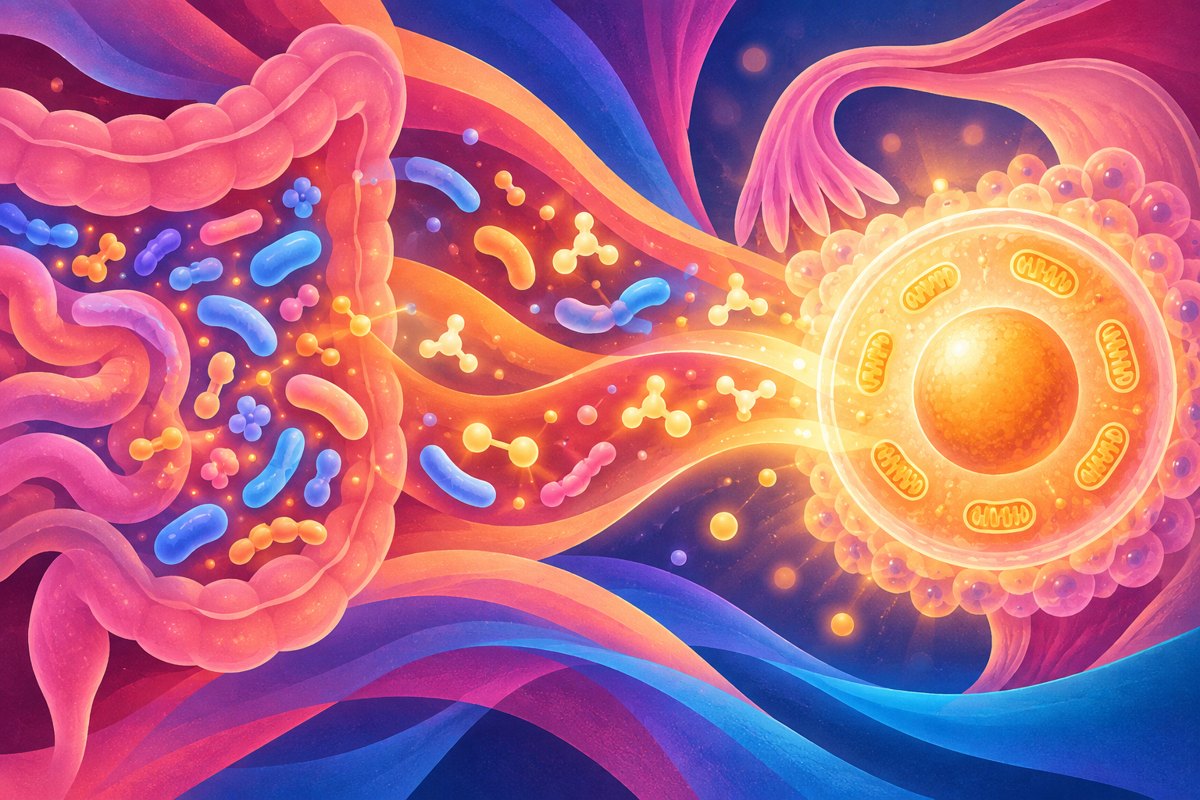
Gut bacteria ferment dietary fiber into short-chain fatty acids, especially butyrate, and those compounds influence how well mitochondria — the energy-producing machinery cells run on — do their job. Eggs are unusually dependent on mitochondria, so anything that shifts mitochondrial performance is at least mechanistically relevant to egg quality. The evidence today is strongest at the level of mechanism and animal studies; in humans it is still observational, which is why we treat gut health as one metabolic input among several rather than a fix on its own.
Why do mitochondria matter so much for egg quality?
A mature human egg carries far more mitochondria than a typical body cell, because the energy demands of maturation, fertilization, and the first several rounds of cell division are exceptionally high. Unlike most cells, the egg does not meaningfully build new mitochondria during that window — it works with the population it already has. Mitochondrial function inside the oocyte affects how accurately chromosomes are separated during division, which is one of the reasons declining mitochondrial performance is considered a meaningful contributor to age-related changes in egg quality. We go deeper into that machinery in our post on how mitochondrial function shapes fertility.
How do gut bacteria influence mitochondrial function?
This is where the gut connection becomes mechanistically specific rather than a vague wellness claim. Gut bacteria ferment fiber into short-chain fatty acids — primarily acetate, propionate and butyrate — which enter circulation and act on mitochondrial activity elsewhere in the body. A 2026 systematic review in Gut Microbes mapped ten classes of gut-derived metabolites against direct mitochondrial endpoints and found butyrate to be one of only four with moderate-certainty evidence: it generally enhances mitochondrial biogenesis (the building of new mitochondria), ATP generation and electron transport chain activity across multiple experimental models. That same review is careful about two things worth repeating here — much of this work is in cells and animals, and several microbial metabolites show biphasic, dose-dependent effects, meaning more is not automatically better.
A separate line of work connects butyrate to a cellular pathway called SIRT1. A 2026 review in Frontiers in Microbiology proposes a gut–butyrate–SIRT1–FoxO1 axis in premature ovarian insufficiency, in which butyrate supports mitochondrial quality control and granulosa-cell survival, with preclinical models showing butyrate supplementation rescuing ovarian function. That is a proposed framework built on animal work, not established human treatment — but it is ovarian tissue specifically, not a general extrapolation.
Can a leaky gut affect egg quality?
The relationship runs in the other direction too. When gut barrier integrity is compromised — often described as increased intestinal permeability — bacterial components such as lipopolysaccharide (LPS) can enter circulation. In cell studies, LPS exposure measurably lowers mitochondrial respiration, and butyrate reverses that drop when it is reintroduced, whether given alongside the LPS or afterward. That work was done in immune cell lines rather than in eggs, so the honest way to state it is this: there is a coherent, two-directional mechanism — a fiber-fed gut producing more butyrate tends to support mitochondrial function, a disrupted gut producing more circulating LPS tends to impair it — and its direct application to human oocytes has not been demonstrated. Inflammation reaching the reproductive system through this kind of route is something we cover more broadly in our post on how inflammation affects fertility.
Is there direct evidence connecting gut bacteria to egg quality?
In animals, yes, and it is fairly striking. A 2026 study in EMBO Molecular Medicine transplanted gut bacteria from young donor mice into aged mice and found it improved ovulation and maturation of aged eggs while reducing cytoplasmic fragmentation and spindle and chromosome abnormalities. The researchers traced the effect to a specific gut-derived metabolite — glutamic acid, modulated by a particular bacterial species — acting through improved mitochondrial function inside the aged eggs, and supplementing glutamic acid on its own reproduced the benefit. This is mouse research and has not been confirmed in humans, but it is a causal demonstration rather than a loose association.
The human data is thinner and, importantly, more complicated. A retrospective study of 147 women undergoing IVF or ICSI found that fecal short-chain fatty acid levels differed between those who achieved a clinical pregnancy and those who did not — but the direction is not the tidy one you might expect: propionate was higher in the group that did not conceive, and higher propionate also tracked with fasting insulin, insulin resistance and triglycerides. Fecal levels reflect what was not absorbed, and this was a cross-sectional look at a fertility-clinic population, so it cannot separate gut metabolites from the metabolic picture around them. It is a real human data point, and it is a good argument against reading "short-chain fatty acids are good, so more must be better" into your own plan. Our post on what to do in the 90 days before IVF retrieval covers the broader window in which egg quality is being actively shaped.
Does this mean a probiotic will improve my egg quality?
No — and that is the part most of the internet gets wrong. Nothing in this research base shows that a specific probiotic, supplement or protocol improves egg quality in humans. What it supports is narrower and still useful: adequate dietary fiber, the raw material gut bacteria use to make butyrate, is a low-risk, mechanistically justified part of a fertility-focused nutrition approach, alongside the better-established factors we cover in our post on supplements studied for egg quality after 40. If you are considering a supplement or a course of probiotics during treatment, that decision belongs with your physician or fertility specialist, who knows what else you are taking.
Gut health also touches fertility through a second, better-documented route that has nothing to do with mitochondria: the estrobolome, the gut bacteria involved in clearing estrogen. We break that down separately in our post on gut bacteria and estrogen clearance.
What actually feeds the bacteria that make butyrate?
Butyrate is not something the body makes on its own — it is produced when specific gut bacteria ferment fiber that reaches the colon intact. That is why the food side of this is mostly unglamorous: a wide variety of plant fiber, including the resistant starch in cooled cooked potatoes, rice, legumes and slightly green bananas, plus oats, beans, and a broad rotation of vegetables rather than the same two every day. Diversity of plant foods tends to track with diversity of the bacteria that do the fermenting. Fermented foods are a reasonable addition, though they work through different mechanisms than fiber does.
It is equally worth knowing what depletes these populations: a long stretch of very low fiber intake, and courses of antibiotics, both of which are common in the year or two before someone starts fertility treatment. Neither is a reason for alarm or for a corrective supplement regimen — it is context, and the recovery lever is the same boring one, which is food. If gut symptoms are prominent enough to be limiting what you eat, that is a conversation for your physician or a gastroenterologist rather than something to work around with fiber powders.
What does this mean for your fertility plan?
Gut bacteria and egg quality are connected through a real mitochondrial mechanism: short-chain fatty acids like butyrate support the same energy machinery eggs depend on heavily, while gut-derived inflammatory byproducts like LPS impair it. Animal work has now shown that connection causally, and early human data links gut metabolite profiles to IVF outcomes — though not in a simple, more-is-better direction. Here in Huntington, we treat gut function as one of several metabolic factors worth looking at when someone is preparing for conception or IVF, not as a standalone explanation and not as a reason to add another shelf of supplements. Our Metabolic & Immune Fertility Evaluation is built to look at that interconnected picture — thyroid, insulin, inflammation, gut function and the rest — rather than any one system in isolation. Patients travel to us from across Long Island and NYC for exactly that kind of workup.
This article is for general educational purposes and isn't a substitute for individualized guidance from your physician or fertility specialist. Any changes to diet or supplementation should be discussed directly with your care team.
East to West Fertility is a metabolic and immune-focused fertility clinic in Huntington, Long Island, serving patients across Long Island, NYC, and beyond. Learn more about our Metabolic & Immune Fertility Evaluation or call 631-416-4940.
References:
- Wang F, et al. "Gut microbiota-modulated glutamic acid rejuvenates the quality of oocytes deteriorated by advanced reproductive age." EMBO Molecular Medicine, 2026. PMC13270145.
- Yao X, et al. "Gut Microbiota-Derived Short Chain Fatty Acids Are Associated with Clinical Pregnancy Outcome in Women Undergoing IVF/ICSI-ET: A Retrospective Study." Nutrients, 2023. PMC10180850.
- Frye RE, et al. "Mechanistic pathways linking gut microbial metabolites, microbial structural products, and host-microbe co-metabolites to mitochondrial function." Gut Microbes, 2026. PMC13456516.
- Weiss SL, et al. "Sodium butyrate reverses lipopolysaccharide-induced mitochondrial dysfunction in lymphoblasts." Journal of Cellular and Molecular Medicine, 2022. PMC9170810.
- Tian S, et al. "Gut microbiota-derived butyrate and the SIRT1/FoxO1 axis: epigenetic-metabolic regulation of ovarian function in premature ovarian insufficiency — a comprehensive review." Frontiers in Microbiology, 2026. PMC13454030.