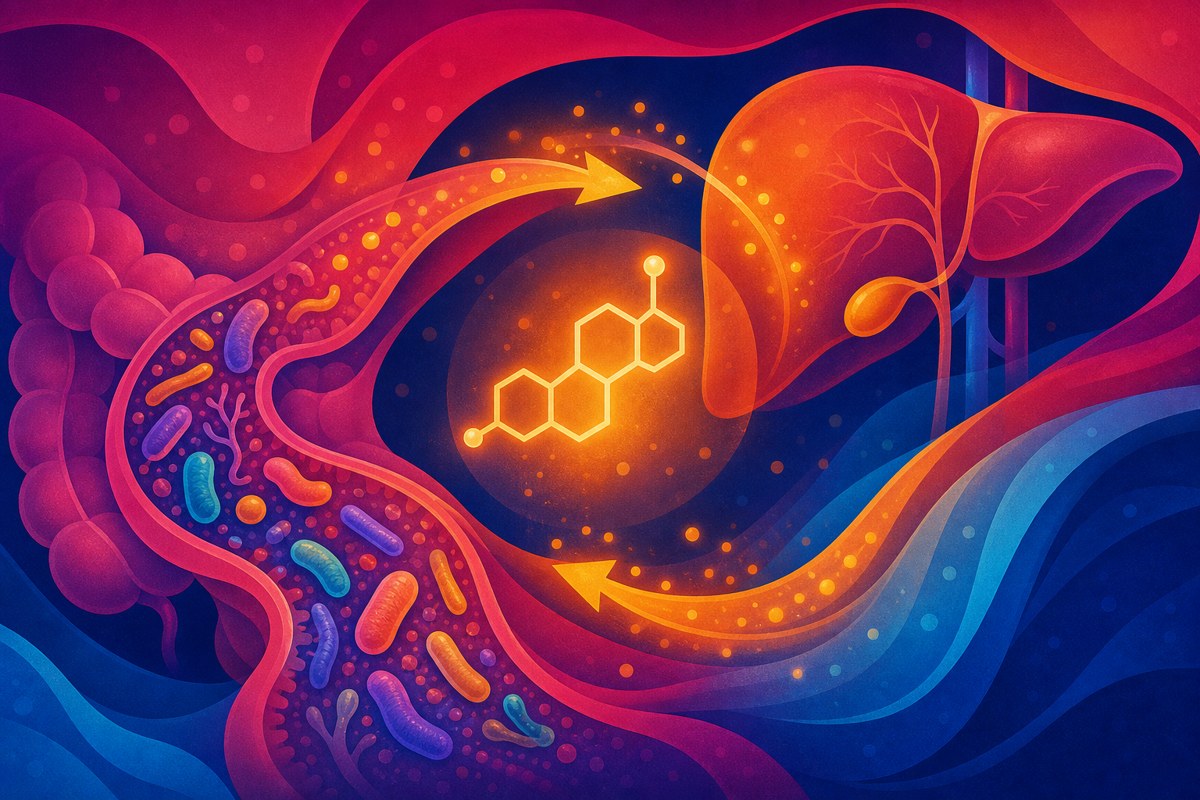
Gut Bacteria, Estrogen Clearance, and Your Fertility
Can your gut bacteria affect how your body clears estrogen — and does that matter for fertility?
Yes, at least in part. A subset of gut bacteria produce enzymes that can reactivate estrogen your liver has already packaged for elimination, sending it back into circulation instead of out of the body. Research links this system — often called the estrobolome — to estrogen-driven conditions such as endometriosis and fibroids, though the human data is still early and mostly association-level rather than proof that changing your gut fixes your hormones.
What is the estrobolome, in plain language?
Your liver does not destroy estrogen. It packages it. Through a process called glucuronidation, the liver attaches a molecular tag to used estrogen so it can be dumped into bile, moved into the intestine, and excreted. That is the exit route.
The estrobolome is the collection of gut bacterial genes involved in estrogen metabolism — a term introduced by Plottel and Blaser in 2011. Some of those bacteria produce an enzyme called beta-glucuronidase, which snips the liver's tag back off. Once the tag is gone, the estrogen is active again and can be reabsorbed through the intestinal wall into the bloodstream.
So the same hormone can leave the liver twice, three times, or more before it finally exits. How efficiently your gut lets estrogen go is a real variable in your hormonal picture, and it is one that a standard fertility workup never looks at.
Why would recirculated estrogen matter when you are trying to conceive?
Estrogen is not the enemy — you cannot build a lining, mature a follicle, or make fertile cervical mucus without it. The issue is proportion and clearance.
Conditions that respond to estrogen exposure include endometriosis and uterine fibroids, both of which are estrogen-dependent by definition. Endometriotic lesions grow and inflame in response to estrogen signaling, and researchers reviewing the microbiome literature have proposed dysregulated microbial estrogen metabolism as one of several contributors to that hyperestrogenic local environment, alongside better-established mechanisms such as local aromatase activity in the lesions themselves.
The second piece is inflammation. Reviews of gut and reproductive-tract microbiota in endometriosis describe raised beta-glucuronidase activity appearing alongside elevated inflammatory cytokines and lipopolysaccharide, not in isolation. That matters clinically, because inflammation affects follicle quality, the receptivity of the lining, and the immune environment an embryo has to implant into. If you want the wider version of that argument, we wrote about how inflammation interferes with fertility in more detail.
How strong is the evidence, honestly?
This is where a lot of the online conversation gets ahead of the science, so it is worth being precise.
What is well established: gut bacteria genuinely do produce beta-glucuronidases that reactivate conjugated estrogens. That was demonstrated biochemically by Ervin and colleagues in the Journal of Biological Chemistry in 2019 — the enzymes are real and their action on estrogen is real.
What is emerging but not settled: whether differences in these bacteria meaningfully drive disease in women. A 2025 systematic review in BMC Women's Health that set out to answer exactly this question for endometriosis and infertility found only five eligible studies. Several reported dysregulated or increased beta-glucuronidase activity in affected women — but at least one analysis of estrogen-related enzyme pathways found no statistically significant difference between groups. The review's own conclusion was that future studies should explore whether modulating the microbiota changes clinical outcomes. That is a research recommendation, not a treatment protocol.
So the honest position is this: the mechanism is real, the association is plausible and being actively studied, and nobody has yet shown that changing your gut bacteria improves fertility outcomes. Anyone selling you certainty here is selling you something.
What would actually be worth investigating?
The pattern that makes this worth a closer look is a gut picture and a hormonal picture that are both off at the same time. Long-standing constipation, bloating, IBS-type symptoms, or a history of repeated antibiotics sitting next to heavy or painful periods, endometriosis, fibroids, breast tenderness that dominates the second half of the cycle, or a short luteal phase.
Stool testing can report beta-glucuronidase activity and broad microbial composition. It is genuinely informative as one input, and it is genuinely oversold as a diagnosis. A number on a stool panel does not tell you why your cycles are painful, and it should never be the only thing a plan is built on. We treat it as one line in a wider metabolic and immune picture — thyroid function, insulin and blood sugar, inflammatory markers, iron, and the actual shape of your cycle — rather than a standalone answer. That is the logic behind our Metabolic & Immune Fertility Evaluation, which is where patients across Huntington and Long Island usually start when the standard workup came back "normal" and the symptoms did not.
What actually supports estrogen clearance?
The interventions with the best rationale are unglamorous, and they are the same ones that support the microbiome generally.
- Fiber, at a real volume. Fiber feeds the bacteria you want, and it moves stool. Estrogen tagged for elimination has to physically leave; slow transit gives beta-glucuronidase more time to work on it.
- Vegetables, including the cruciferous family. Broad plant intake is what shifts microbial composition in the studies that have measured it.
- Less ultra-processed food. Not a moral position — it is the most reliable lever anyone has found on microbial diversity.
- Regular bowel movements as a fertility marker. If you are going every third day, that is a clearance problem worth addressing before it is a supplement problem.
- Blood sugar stability. Insulin resistance changes both the gut environment and sex-hormone binding, which is why we look at it alongside anything estrogen-related.
What we do not do is put patients on enzyme-inhibiting or hormone-modulating supplement stacks based on a stool test. If you have endometriosis or fibroids, decisions about medical or surgical management belong with your OB-GYN or reproductive endocrinologist, and our role sits alongside that care, not in place of it — the same framing we use in our work on acupuncture for endometriosis-related fertility cases.
Does this replace anything in your current plan?
No. If you are mid-cycle in IVF, or you have a diagnosed estrogen-dependent condition with a surgical plan, this is a layer underneath that plan, not an alternative to it. Where it earns its place is in the group we see constantly: cycles that hurt, labs that look acceptable, a gut that has been quietly miserable for a decade, and no one connecting the two. Our PCOS and endometriosis care page explains how we structure that alongside conventional treatment.
The bottom line
Gut bacteria can reactivate estrogen your liver already prepared for exit, and that mechanism plausibly feeds into estrogen-dependent conditions that affect fertility. The biochemistry is solid; the clinical evidence in women is early and mixed, and it does not yet support treating a stool test as a diagnosis. What it does support is taking digestion seriously as part of a hormonal workup instead of treating it as a separate department. Here in Huntington, that means asking about your bowels in a fertility consult — and meaning it.
This article is for general educational purposes and isn't a substitute for individualized guidance from your OB-GYN, reproductive endocrinologist, or gastroenterologist. Any diagnosis or treatment decision about endometriosis, fibroids, or gastrointestinal disease should be made with your care team.
East to West Fertility is a metabolic and immune-focused fertility clinic in Huntington, Long Island, serving patients across Long Island, NYC, and beyond. Learn more about our Metabolic & Immune Fertility Evaluation or call 631-416-4940.
References:
- Plottel CS, Blaser MJ. "Microbiome and malignancy." Cell Host & Microbe, 2011 — original description of the estrobolome.
- Ervin SM, et al. "Gut microbial beta-glucuronidases reactivate estrogens as components of the estrobolome that reactivate estrogens." Journal of Biological Chemistry, 2019;294(49):18586-18599.
- "Could the estrobolome have a role in endometriosis pathogenesis and infertility? A systematic review." BMC Women's Health, 2025. doi:10.1186/s12905-025-04195-z (PMC12821278).
- "Impact of Gut and Reproductive Tract Microbiota on Estrogen Metabolism in Endometriosis." American Journal of Reproductive Immunology, 2025. doi:10.1111/aji.70109.
- "Unraveling the Contribution of Estrobolome Alterations to Endometriosis Pathogenesis." Current Issues in Molecular Biology, 2025. doi:10.3390/cimb47070502.
The reproductive tract has its own microbial community, and the research there is moving quickly. We cover what it means for embryo transfer in the uterine microbiome and IVF implantation.
The estrobolome is one of two routes from the gut to fertility. The other runs through cellular energy: see our post on gut health, egg quality and the mitochondrial link.
The same bacterial machinery works on androgens too, and that side of it matters most in PCOS — we cover the gut–testosterone research, including what a widely repeated claim about Clostridium scindens actually says, in gut bacteria and testosterone. Worth adding on the endometriosis side: a 2019 study in Human Reproduction (Chadchan et al., 34(6):1106-1116) found antibiotic treatment with metronidazole slowed endometriosis progression in mice, apparently by suppressing specific gut bacteria — mouse work, but it is the study most often cited as direct evidence that the gut microbiome can influence lesion growth rather than merely accompany it.