Gut Bacteria and Testosterone: What PCOS Research Shows
Can gut bacteria actually raise testosterone — and does that matter for PCOS?
Gut bacteria do act on androgens directly: they can strip the tag your liver attaches to testosterone and DHT for disposal, reactivating those hormones inside the intestine, and at least one gut species can convert the stress hormone cortisol into an androgen. That makes the gut a genuine variable in androgen metabolism, which matters because androgen excess is the defining feature of PCOS. What has not been shown is that changing your gut bacteria corrects androgen excess in women — the human evidence is association-level, and the causal work so far is in mice.
What does the gut have to do with androgens at all?
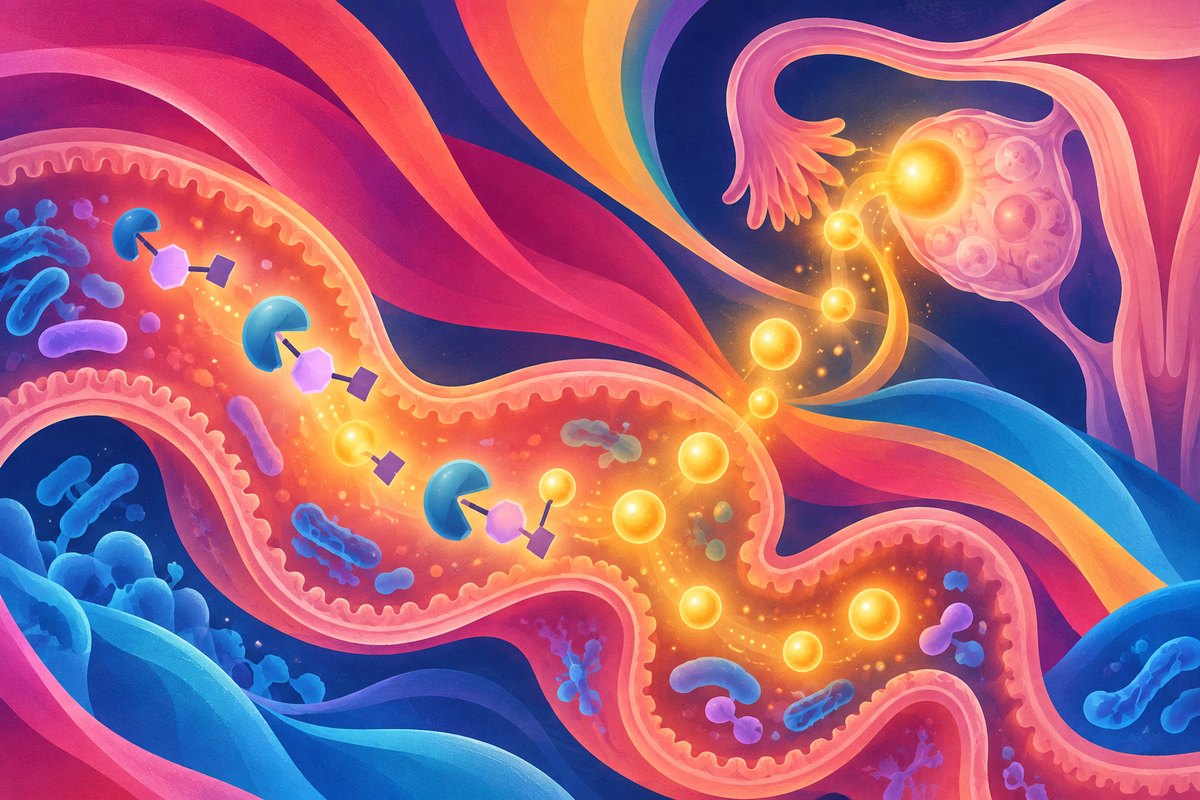
The same disposal system that handles estrogen also handles testosterone. The liver attaches a molecule (glucuronic acid) to used hormones, which deactivates them and marks them for excretion through bile into the intestine. Gut bacteria produce enzymes that can snip that tag back off, releasing the active hormone into the intestinal contents.
How large is that effect? A 2019 study in American Journal of Physiology — Endocrinology and Metabolism measured androgens along the intestine by mass spectrometry. In the upper small intestine, where bacterial density is low, testosterone and DHT were mostly still tagged and inactive. In the colon, where bacterial density is high, free DHT — the most potent androgen the body makes — reached levels more than twenty times higher than in blood in mice, and in young healthy men, fecal free DHT ran more than seventy times higher than serum. Germ-free mice, raised without any gut bacteria, kept their androgens tagged and had very little free DHT in the distal intestine. That is about as clean a demonstration as you get: the deactivation is the liver's work, and the reactivation is bacterial.
Does a gut bacterium really "make testosterone"?
This claim circulates widely online, and it is worth getting exactly right, because the popular version overstates the primary research.
The bacterium in question is Clostridium scindens. What it was actually shown to do, in a 2013 paper in the Journal of Lipid Research, is cleave the side chain off cortisol using an enzyme called steroid-17,20-desmolase, producing 11β-hydroxyandrostenedione — a C19 androgen, but not testosterone. A follow-up paper identified the specific bacterial genes (desA and desB) responsible. A widely cited 2017 review in Maturitas then described testosterone as being "produced in the gut by Clostridium scindens" and coined the term "testrobolome" by analogy with the estrobolome. The term is useful; that particular sentence goes further than the paper it cites.
So is the corrected version less interesting?
No — arguably more, once you know where 11β-hydroxyandrostenedione goes next. Human enzymes convert it onward into 11-ketotestosterone, which binds and activates the androgen receptor with potency comparable to testosterone itself.
And that family of hormones turns out to be central in PCOS. A 2017 study in the Journal of Clinical Endocrinology & Metabolism measured the full androgen profile in women with PCOS and healthy controls, and found that 11-oxygenated androgens made up the majority of circulating androgens in the PCOS group — a larger share of the total than in controls, and elevated in lean and higher-weight patients alike. Two of those steroids also tracked with markers of insulin resistance. So a bacterial route that feeds into the 11-oxygenated pathway is pointed at the androgens that matter most in PCOS, rather than at a side pathway. That is mechanistic plausibility, not a measured contribution in patients — nobody has quantified how much of a woman's androgen load comes from her gut.
What do we actually see in the gut of women with PCOS?
The largest careful human comparison sequenced stool from women with PCOS, women with polycystic ovarian morphology only, and healthy controls (published in JCEM in 2018, 163 women in total). Microbial diversity was lower in the PCOS group, with the morphology-only group sitting in between. Diversity was inversely related to hyperandrogenism, total testosterone, and hirsutism — the more androgen excess, the less diverse the microbiome.
Here is the part most summaries drop: the authors' own conclusion pointed the arrow the other way, suggesting hyperandrogenism may be what alters the gut microbiome in PCOS. A correlation like this cannot tell you which came first, and honest reading has to allow that the hormones may be shaping the bacteria rather than the reverse.
Is there evidence the gut can cause PCOS features, not just accompany them?
In animals, yes. A 2019 study in Nature Medicine found one bacterium, Bacteroides vulgatus, markedly elevated in women with PCOS alongside reduced levels of specific bile acids. When the researchers transplanted stool from women with PCOS into mice — or colonized mice with that single bacterium — the recipient mice developed disrupted cycles, insulin resistance, altered bile acid metabolism, lower interleukin-22, and infertility. Giving those mice either IL-22 or the missing bile acid improved the picture.
That is a real causal chain, and it is a mouse chain. It establishes that gut bacteria can drive PCOS-like features in an animal. It does not establish that treating the gut resolves PCOS in a woman, and the study's authors framed microbiome modification as something that "may be of value," not as a protocol.
Do probiotics help, then?
Somewhat, modestly, and not in every measure people expect. A 2026 meta-analysis in BMC Endocrine Disorders pooled eleven randomized controlled trials of probiotic or synbiotic supplementation in PCOS, covering 780 participants. It found small but consistent reductions in total testosterone, fasting insulin, triglycerides, LDL cholesterol, BMI and body weight, with the certainty of evidence rated high for the testosterone and lipid findings. It found no significant effect on fasting glucose, HOMA-IR, SHBG, DHEAS, LH or FSH.
An earlier randomized trial of a multi-strain probiotic in women with PCOS pointed the same way: differences appeared in some hormonal markers and BMI, not across the board. So the fair summary is that this pathway is modifiable, the size of the change is modest, the trials are short, and a supplement is not a substitute for the parts of PCOS care that are established. Anything you take is a conversation for your OB-GYN or reproductive endocrinologist alongside the rest of your plan — we do not prescribe or replace it.
Where does the estrogen side of this fit?
The androgen route described here is the second half of a two-part story. The first half runs through estrogen: the same class of bacterial enzymes reactivates estrogen the liver had packaged for exit, which is the system usually called the estrobolome. We cover that mechanism and its links to endometriosis and fibroids in our article on how gut bacteria affect estrogen clearance. Read together, the picture is one hormone-disposal route with bacteria sitting at the exit door for both estrogens and androgens.
What we do with this at our Huntington clinic
We treat digestion as part of a hormonal workup, not a separate department. The pattern worth investigating is androgen symptoms and gut symptoms in the same person: irregular or absent cycles, acne or hirsutism, elevated testosterone or a raised androgen ratio, sitting next to long-standing constipation, bloating, IBS-type symptoms, or repeated courses of antibiotics.
What that changes in practice is unglamorous and evidence-aligned: fiber at a real volume, broad plant intake, regular bowel movements treated as a hormonal variable rather than a comfort issue, and blood sugar stability — because insulin resistance drives ovarian androgen production and lowers SHBG, which is the mechanism our post on insulin resistance and fertility works through in detail. What we do not do is treat a stool panel as a diagnosis or build a supplement stack on one. Patients across Huntington and Long Island usually come to us after a standard workup came back acceptable and the symptoms did not agree; the gut is one line in a wider metabolic and immune picture, and our PCOS and endometriosis care page explains how we structure that alongside conventional treatment. For the wider argument that PCOS is a whole-body condition rather than an ovarian one, see why PCOS isn't an ovary problem.
The bottom line
Gut bacteria demonstrably reactivate androgens in the intestine, and one gut species can turn cortisol into an androgen precursor that feeds the exact hormone family that dominates androgen excess in PCOS. That biochemistry is solid. What is not settled is direction and magnitude in women: the human data is correlational and may partly reflect androgens shaping the microbiome, the causal work is in mice, and supplement trials show modest changes in some markers and none in others. Which is enough to make the gut worth asking about in a PCOS workup, and not enough to make it the answer.
This article is for general educational purposes and isn't a substitute for individualized guidance from your physician. Any changes to diet, supplementation, or treatment for PCOS or hormone-related conditions should be discussed directly with your OB-GYN, reproductive endocrinologist, or care team.
East to West Fertility is a metabolic and immune-focused fertility clinic in Huntington, Long Island, serving patients across Long Island, NYC, and beyond. Learn more about our Metabolic & Immune Fertility Evaluation or call 631-416-4940.
References:
- Colldén H, Landin A, Wallenius V, et al. "The gut microbiota is a major regulator of androgen metabolism in intestinal contents." American Journal of Physiology — Endocrinology and Metabolism, 2019;317(6):E1182-E1192.
- Ridlon JM, Ikegawa S, Alves JMP, et al. "Clostridium scindens: a human gut microbe with a high potential to convert glucocorticoids into androgens." Journal of Lipid Research, 2013;54(9):2437-2449.
- Devendran S, Mythen SM, Ridlon JM. "The desA and desB genes from Clostridium scindens ATCC 35704 encode steroid-17,20-desmolase." Journal of Lipid Research, 2018;59(6):1005-1014.
- Baker JM, Al-Nakkash L, Herbst-Kralovetz MM. "Estrogen-gut microbiome axis: physiological and clinical implications." Maturitas, 2017;103:45-53 — source of the term "testrobolome."
- O'Reilly MW, Kempegowda P, Jenkinson C, et al. "11-Oxygenated C19 steroids are the predominant androgens in polycystic ovary syndrome." Journal of Clinical Endocrinology & Metabolism, 2017;102(3):840-848.
- Torres PJ, Siakowska M, Banaszewska B, et al. "Gut microbial diversity in women with polycystic ovary syndrome correlates with hyperandrogenism." Journal of Clinical Endocrinology & Metabolism, 2018;103(4):1502-1511.
- Qi X, Yun C, Sun L, et al. "Gut microbiota-bile acid-interleukin-22 axis orchestrates polycystic ovary syndrome." Nature Medicine, 2019;25(8):1225-1233.
- Szydłowska I, Nawrocka-Rutkowska J, Gorzko A, et al. "Changes in hormonal profile and body mass index in women with polycystic ovary syndrome after probiotic intake: a 12-week placebo-controlled and randomized clinical study." Nutrients, 2025;17(3):405.
- Sun Z, Zhang R, Tian X, Li T, Liu Z. "Efficacy of probiotic and synbiotic supplementation on metabolic and endocrine parameters in polycystic ovary syndrome: a meta-analysis of randomized controlled trials." BMC Endocrine Disorders, 2026.