AMH Test Results: What the Number Can and Cannot Tell You
An AMH result can arrive by patient portal with no explanation attached, and it can reset the emotional temperature of a whole fertility plan in about ten seconds. Then a second test at a different lab comes back with a different number, or a clinic calls the same value "low" that another called "fine," and the confusion gets worse. Before you build a plan around that figure, it is worth knowing exactly what an AMH test measures, what moves it, and which questions it was never able to answer.
What do your AMH test results actually mean?
An AMH result is an estimate of how many small growing follicles your ovaries currently carry, which is why it is used to predict how ovaries are likely to respond to stimulation in IVF. It is not a measure of egg quality, of whether you will conceive this year, or of when you will reach menopause, and the same blood can produce different numbers on different laboratory platforms and in different units. Read it as one line in a larger picture that includes your age, ultrasound, cycle pattern, prior treatment response, metabolic and immune markers, and sperm testing.
How is AMH produced, and why does that limit what it measures?
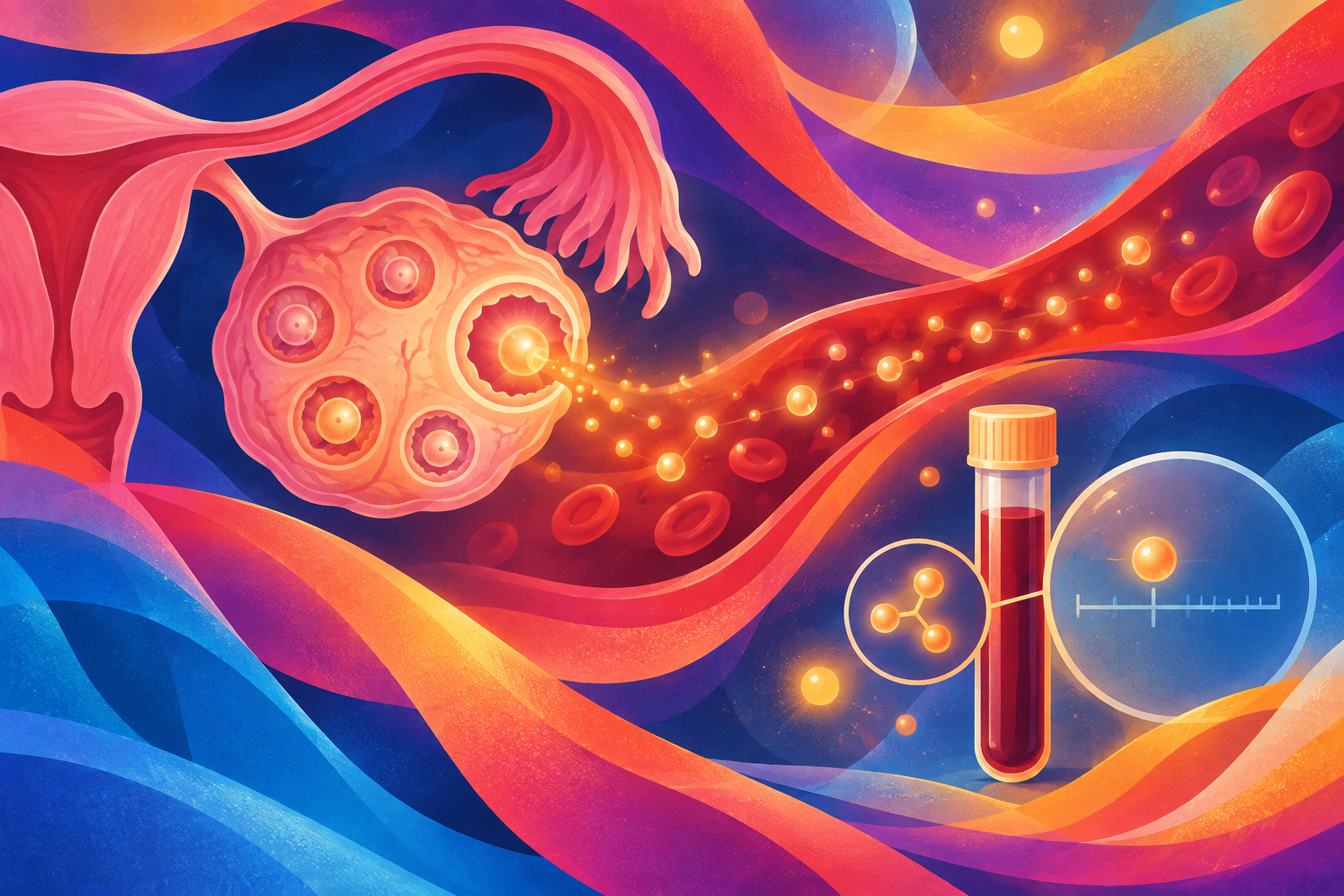
Anti-Müllerian hormone is made by granulosa cells, the cells that surround an immature egg inside a follicle. Production is concentrated in preantral and small antral follicles — follicles that have left the resting pool and begun to grow — and it falls away sharply as a follicle is selected and matures. That is the whole biological basis of the test: the hormone in your blood is a by-product of the small growing population, so it tracks the size of the recruitable pool indirectly, as reviewed by Dewailly and colleagues in Human Reproduction Update.
Two consequences follow, and both get lost in translation. First, AMH says nothing directly about the resting primordial follicles that make up most of the ovarian supply; it reports on the small fraction currently in motion. Second, because the hormone comes from follicle numbers, it cannot report on the condition of the eggs inside them. Our comparison of what AMH and an antral follicle count each measure walks through why a blood marker and an ultrasound count can disagree and still both be correct.
Why do two labs give different AMH numbers from the same blood?
This is the part patients are rarely told. There is no single universal AMH assay. Commercial platforms are calibrated differently, and they are not interchangeable: Iliodromiti and colleagues compared automated assays in Human Reproduction in 2017 and reported non-equivalence significant enough to matter when a number is used as a companion diagnostic for dosing, and Su and colleagues found the same problem across commercially available immunoassays in Fertility and Sterility. Molecular forms of AMH also vary in follicular fluid and granulosa cells, which is part of why assays that detect slightly different targets disagree.
Units add a second layer. Results are reported in either ng/mL or pmol/L, and the conversion is roughly seven-fold (1 ng/mL ≈ 7.14 pmol/L). A value that looks alarming in one set of units can be unremarkable in the other. Before you compare two AMH results, confirm three things: the laboratory, the assay platform, and the units. If any of the three changed, you may be looking at a measurement artifact rather than a biological change — the same reasoning we apply to reading fertility labs as a trend instead of a single snapshot.
Does the day of your cycle change an AMH result?
AMH is often described as cycle-independent, and that convenience is why it appears in so many workups. It is mostly true, not entirely true. Kissell and colleagues tracked serum AMH across the menstrual cycle in 259 eumenorrheic women (Human Reproduction, 2014) and found measurable biological variation within a cycle, with a different pattern in sporadic anovulatory cycles. The practical reading: timing is not a reason to delay the test, but a modest difference between two draws weeks apart is not automatically a decline in ovarian reserve.
What can lower an AMH result without meaning your reserve dropped?
Several common situations suppress the number rather than the supply.
- Combined hormonal contraception. Kallio and colleagues showed AMH levels fall during combined contraception regardless of administration route (Fertility and Sterility, 2013), and Dólleman and colleagues found lower AMH in users in a large population-based study (Journal of Clinical Endocrinology & Metabolism, 2013). A result drawn on the pill, patch or ring is not a clean baseline.
- Recent ovarian surgery. A systematic review and meta-analysis by Raffi and colleagues found AMH falls after excision of ovarian endometriomas (Journal of Clinical Endocrinology & Metabolism, 2012). The timing of a test relative to surgery changes its meaning.
- Pregnancy and the postpartum window, along with some medical treatments, can shift levels temporarily.
- Assay and unit changes, as above — the single most common explanation for a result that "dropped" between two clinics.
None of that makes a low number meaningless. It means the number has context, and the context should be established before any plan is rewritten around it. If your result is low and your cycles look normal, the pairing of markers matters more than any single value, which is why we wrote separately about low AMH alongside a raised FSH with regular cycles and about what actually causes low egg reserve.
Does a high AMH mean you have plenty of eggs?
Not necessarily, and being told "you have plenty of eggs" is one of the least useful sentences a woman with a high AMH and no pregnancy can hear. Higher values often reflect a large population of small follicles that are not progressing efficiently to ovulation. Pigny and colleagues linked elevated serum AMH in PCOS to both follicle excess and follicular arrest (Journal of Clinical Endocrinology & Metabolism, 2003) — the eggs are present, the selection and release mechanism is not working smoothly.
High AMH is also not a diagnosis by itself. The 2023 International Evidence-based Guideline for PCOS now accepts serum AMH as an alternative to ultrasound for defining polycystic ovarian morphology in adults, but PCOM is only one criterion; the diagnosis still requires the wider picture of ovulatory dysfunction and clinical or biochemical hyperandrogenism, with other causes excluded. Our walkthrough of how PCOS is actually diagnosed covers where a high AMH does and does not fit, and what to investigate next — insulin signaling, androgens, inflammation and ovulatory rhythm rather than the follicle count alone.
Can AMH predict natural conception or the age you reach menopause?
These are the two questions patients most want answered, and the evidence is clear that AMH answers neither well for an individual. Steiner and colleagues followed 750 women aged 30 to 44 with no history of infertility (JAMA, 2017) and found that neither a low AMH nor a raised FSH was associated with a reduced chance of conceiving within six or twelve cycles of trying. For menopause, a 2023 systematic review by Nelson and colleagues in Human Reproduction Update concluded that AMH is useful for population-level modelling but not precise enough to tell one woman the year her periods will stop.
The American Society for Reproductive Medicine's committee opinion on ovarian reserve testing draws the same boundary: these tests describe likely response to stimulation, and they should not be used as standalone fertility forecasts or as a reason to withhold treatment. A low result is information about planning and timing, not a verdict on whether a pregnancy can happen.
Does AMH say anything about egg quality or embryo outcomes?
Partly, and in a narrower way than most people assume. AMH is a reasonable predictor of the number of eggs retrieved in IVF, but Iliodromiti and colleagues' systematic review and meta-analysis in Human Reproduction Update (2014) found its accuracy for predicting a live birth after assisted conception to be poor. Morin and colleagues studied patients under 38 with diminished ovarian reserve (Human Reproduction, 2018) and described a quantitative rather than a qualitative reduction — fewer eggs, without the aneuploidy pattern of an older ovary. Other work disagrees at the margins: Li, Seifer and Tal reported that AMH independently predicted aneuploidy but not live birth per transfer in PGT-A cycles (Reproductive Biology and Endocrinology, 2023), and Tal and colleagues found AMH correlated with cumulative live births in diminished reserve independent of age (Journal of Clinical Endocrinology & Metabolism, 2021).
Age remains the dominant driver of chromosomal abnormality: Franasiak and colleagues' review of 15,169 trophectoderm biopsies (Fertility and Sterility, 2014) maps that rise clearly. What AMH does not measure at all is the cellular machinery that egg maturation depends on. May-Panloup and colleagues' review of mitochondria in oocytes and follicles (Human Reproduction Update, 2016) describes the energy demands of maturation, chromosome separation, fertilization and early division — none of which appear in a follicle-count hormone. That gap is exactly why some patients with an unremarkable AMH still see embryos stall before the blastocyst stage, and why the male side needs its own investigation through sperm DNA fragmentation testing a standard semen analysis misses.
When is it worth rechecking AMH, and when should you look deeper?
A repeat test earns its place when the first result was unexpected or inconsistent with the ultrasound, when it was run on a different platform or in different units, when it was drawn during contraception or soon after ovarian surgery, or when a reproductive endocrinologist needs current data for IVF planning. Repeating it every few months with no decision attached mostly buys anxiety. Ordering and interpreting these tests sits with your OB-GYN or reproductive endocrinologist; we are an acupuncture and functional-medicine clinic and do not order labs or prescribe.
The more productive move, after low AMH with poor stimulation response, repeated IVF disappointment, recurrent loss, or a year of trying with "normal" labs, is to widen the question. Ask how your AMH lines up with your antral follicle count, early-cycle FSH and estradiol, confirmed ovulation, thyroid and immune markers, insulin and metabolic data, prior retrieval and embryo results, and a full sperm evaluation. Patients we see across Huntington and the rest of Long Island frequently arrive with one number heavily interpreted and half of that list never run.
How should an AMH result sit inside a fertility plan?
At our Huntington clinic, AMH is treated as one input into a Personalized 90-Day Fertility Roadmap built from a Metabolic & Immune Fertility Evaluation, not as the headline. We review lab trends rather than isolated draws, ovarian imaging and follicle counts, cycle symptoms and confirmed ovulation, metabolic and body-composition data, thyroid and immune patterns, microbiome findings when clinically appropriate, and advanced sperm testing — then work the three dials we can actually influence: Blood Flow & Signaling, Egg & Sperm Quality, and the Fertility Environment.
No treatment, supplement or protocol recreates the follicle supply you were born with, and anything marketed as reversing ovarian ageing deserves hard scrutiny. What can change is the environment the remaining follicles develop in — blood flow, inflammation, insulin signaling, thyroid function, nutrient status, sleep, stress physiology and the sperm contribution. Across Long Island we see the same pattern: the plan improves once the AMH result is put back in proportion and the rest of the system gets examined.
Your AMH deserves to be taken seriously, and so do the symptoms, history and outcomes it cannot explain. If your number has been interpreted for you in one sentence, the next step is not panic or false reassurance — it is a precise look at what your reproductive system needs now. Our Metabolic & Immune Fertility Evaluation is built for exactly that conversation, and a free 10-minute call is the simplest way to find out whether it fits your situation.
This article is for educational purposes only and is not medical advice. It does not replace care from your OB-GYN or reproductive endocrinologist. Always discuss testing, diagnosis and treatment decisions with your own medical team.
East to West Fertility is a metabolic and immune-focused fertility clinic in Huntington, Long Island, serving patients across Long Island, NYC, and beyond. Learn more about our Metabolic & Immune Fertility Evaluation or call 631-416-4940.
References:
- Dewailly D, Andersen CY, Balen A, et al. "The physiology and clinical utility of anti-Müllerian hormone in women." Human Reproduction Update, 2014;20(3):370-385.
- Iliodromiti S, Anderson RA, Nelson SM. "Technical and performance characteristics of anti-Müllerian hormone and antral follicle count as biomarkers of ovarian response." Human Reproduction Update, 2015;21(6):698-710.
- Iliodromiti S, Salje B, Dewailly D, et al. "Non-equivalence of anti-Müllerian hormone automated assays — clinical implications for use as a companion diagnostic for individualised gonadotrophin dosing." Human Reproduction, 2017;32(8):1710-1715.
- Su HI, Sammel MD, Homer MV, Bui K, Haunschild C, Stanczyk FZ. "Comparability of antimüllerian hormone levels among commercially available immunoassays." Fertility and Sterility, 2014;101(6):1766-1772.e1.
- Mamsen LS, Bøtkjær JA, Kristensen SG, et al. "High variability of molecular isoforms of AMH in follicular fluid and granulosa cells from human small antral follicles." Frontiers in Endocrinology, 2021;12:617523.
- Kissell KA, Danaher MR, Schisterman EF, et al. "Biological variability in serum anti-Müllerian hormone throughout the menstrual cycle in ovulatory and sporadic anovulatory cycles in eumenorrheic women." Human Reproduction, 2014;29(8):1764-1772. (259 women.)
- Kallio S, Puurunen J, Ruokonen A, Vaskivuo T, Piltonen T, Tapanainen JS. "Antimüllerian hormone levels decrease in women using combined contraception independently of administration route." Fertility and Sterility, 2013;99(5):1305-1310.
- Dólleman M, Verschuren WM, Eijkemans MJ, et al. "Reproductive and lifestyle determinants of anti-Müllerian hormone in a large population-based study." Journal of Clinical Endocrinology & Metabolism, 2013;98(5):2106-2115.
- Raffi F, Metwally M, Amer S. "The impact of excision of ovarian endometrioma on ovarian reserve: a systematic review and meta-analysis." Journal of Clinical Endocrinology & Metabolism, 2012;97(9):3146-3154. (8 prospective cohorts, 237 patients.)
- Pigny P, Merlen E, Robert Y, et al. "Elevated serum level of anti-Müllerian hormone in patients with polycystic ovary syndrome: relationship to the ovarian follicle excess and to the follicular arrest." Journal of Clinical Endocrinology & Metabolism, 2003;88(12):5957-5962.
- Teede HJ, Tay CT, Laven J, et al. "Recommendations from the 2023 International Evidence-based Guideline for the Assessment and Management of Polycystic Ovary Syndrome." Fertility and Sterility, 2023;120(4):767-793.
- Steiner AZ, Pritchard D, Stanczyk FZ, et al. "Association between biomarkers of ovarian reserve and infertility among older women of reproductive age." JAMA, 2017;318(14):1367-1376. (750 women aged 30-44.)
- Nelson SM, Davis SR, Kalantaridou S, Lumsden MA, Panay N, Anderson RA. "Anti-Müllerian hormone for the diagnosis and prediction of menopause: a systematic review." Human Reproduction Update, 2023;29(3):327-346.
- Practice Committee of the American Society for Reproductive Medicine. "Testing and interpreting measures of ovarian reserve: a committee opinion." Fertility and Sterility, 2020;114(6):1151-1157.
- Iliodromiti S, Kelsey TW, Wu O, Anderson RA, Nelson SM. "The predictive accuracy of anti-Müllerian hormone for live birth after assisted conception: a systematic review and meta-analysis." Human Reproduction Update, 2014;20(4):560-570.
- Morin SJ, Patounakis G, Juneau CR, Neal SA, Scott RT, Seli E. "Diminished ovarian reserve and poor response to stimulation in patients <38 years old: a quantitative but not qualitative reduction in performance." Human Reproduction, 2018;33(8):1489-1498.
- Li HJ, Seifer DB, Tal R. "AMH independently predicts aneuploidy but not live birth per transfer in IVF PGT-A cycles." Reproductive Biology and Endocrinology, 2023;21(1):19.
- Tal R, Seifer DB, Tal R, Granger E, Wantman E, Tal O. "AMH highly correlates with cumulative live birth rate in women with diminished ovarian reserve independent of age." Journal of Clinical Endocrinology & Metabolism, 2021;106(9):2754-2766. (SART registry analysis.)
- Franasiak JM, Forman EJ, Hong KH, et al. "The nature of aneuploidy with increasing age of the female partner: a review of 15,169 consecutive trophectoderm biopsies." Fertility and Sterility, 2014;101(3):656-663.
- May-Panloup P, Boucret L, Chao de la Barca JM, et al. "Ovarian ageing: the role of mitochondria in oocytes and follicles." Human Reproduction Update, 2016;22(6):725-743.