Natural Ways to Restore Ovulation in PCOS
What natural methods actually help restore ovulation in PCOS?
No single supplement or smoothie recipe restores ovulation, but targeted nutrition, movement, sleep, and stress regulation can meaningfully reduce the insulin and inflammatory signals keeping follicles stuck in arrest. For some patients, natural approaches alone aren't enough in an acceptable timeframe, and evidence-based medications like letrozole may be added under a reproductive endocrinologist's guidance — that's not a failure of the natural approach, it's using every available tool. More on that here: how long it takes to regulate PCOS cycles naturally.
The Question You’re Really Asking When You Have PCOS and Aren’t Ovulating
Many women who come into our Huntington, Long Island clinic with polycystic ovary syndrome (PCOS) ask some version of the same question:
“I’m not ovulating regularly. What natural methods actually help restore ovulation in PCOS, and what is just noise on the internet?”
Behind that question are a few others:
“Can I do anything besides taking more pills?”
“Is it already too late for my ovaries?”
“If I change my food, movement, supplements, or add acupuncture, does it really change what my ovaries are doing, or is it just wishful thinking?”
You deserve an answer that respects how serious this feels, without promising that a smoothie recipe or a handful of supplements will cure PCOS. This article will walk you through how ovulation breaks in PCOS, which non‑pharmacologic approaches have the best evidence and biologic logic, and how we weave them together using our Mitochondrial‑Based Fertility Care Model.
What Actually Goes Wrong in PCOS Ovulation (Western Lens)
Insulin resistance, androgen excess, and disrupted signaling
PCOS is not just “cysts on the ovaries.” At its core, in many women it is a metabolic and hormonal signaling disorder that affects ovulation:
Insulin resistance: Your muscles, liver, and fat tissue do not respond normally to insulin, so your pancreas makes more. High insulin stimulates the ovaries to produce more androgens (like testosterone) and alters follicle development.
Androgen excess: Elevated androgens interfere with the normal maturation of follicles and can blunt the rise of follicle‑stimulating hormone (FSH) relative to luteinizing hormone (LH).
Abnormal GnRH/LH pulsatility: The brain’s GnRH “pulse generator” tends to favor faster pulses that drive high LH and relatively lower FSH. That pattern promotes androgen production over coordinated follicle growth.
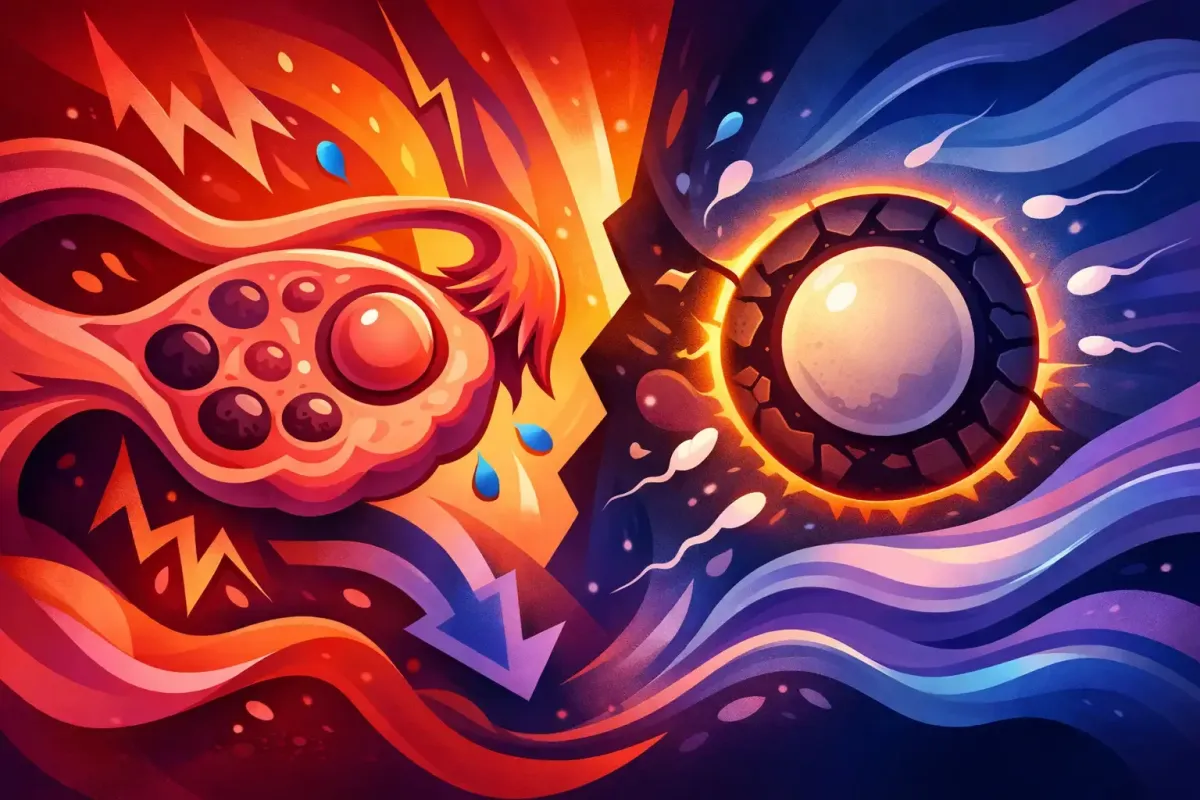
The result is that many follicles start to grow but stall out in a “mid‑growth” phase rather than selecting one dominant follicle that ovulates. On ultrasound this looks like the classic “string of pearls” pattern. Clinically, it looks like long, irregular cycles or no periods at all.
Follicular arrest, mitochondrial stress, and the cellular environment
Inside each of those stalled follicles is an oocyte (egg) and a ring of granulosa and theca cells. At the microscopic level, several things are happening in PCOS:
Mitochondrial dysfunction: The mitochondria in ovarian cells may be under constant pressure from high insulin, high glucose, and chronic low‑grade inflammation. That can impair ATP production and increase oxidative stress.
Altered local blood flow: Insulin resistance, central adiposity, and chronic inflammation can all affect pelvic microcirculation, which means variable oxygen and nutrient delivery to follicles.
Inflammatory signaling: Adipose‑derived cytokines, gut‑derived endotoxin, and local inflammatory mediators can further disrupt granulosa cell function and hormone production.
Ovulation is an energy‑intensive, precisely timed event. If mitochondria cannot produce consistent ATP, if blood flow is sluggish, and if inflammatory signals are high, the system tends to stay in “follicular arrest” instead of completing a healthy ovulation.
Our Mitochondrial‑Based Fertility Care Model
Mapping metabolic and hormonal terrain with Western diagnostics
At East to West Fertility, we start by mapping your PCOS “terrain” using Western data, usually including: That is the focus of Metabolic & Immune Fertility Evaluation.
Cycle history and ovulation tracking (LH strips, basal body temperature, or ultrasound when indicated)
Hormone profile (LH, FSH, estradiol, progesterone, total and free testosterone, SHBG, DHEAS)
Metabolic markers (fasting glucose, insulin, HOMA‑IR, lipid panel, sometimes oral glucose tolerance)
Thyroid function and prolactin (to rule out other causes of anovulation)
Vitamin D and, when needed, inflammatory markers
We use these to answer: Where is mitochondrial and vascular stress coming from? Is the primary driver insulin resistance, chronic inflammation, sleep disruption, stress hormones, or a mixture?
Translating those patterns into TCM patterns
In Traditional Chinese Medicine (TCM), we then evaluate:
Pulses, tongue, and body temperature patterns
Bleeding pattern when you do get a period (amount, clots, pain)
Digestive function, bowel patterns, and bloating
Energy, mood, and sleep quality
Many women with PCOS fit blended TCM patterns such as:
Spleen Qi deficiency with dampness/phlegm: fatigue, bloating, weight gain, cystic acne, “heaviness”
Liver Qi stagnation and Blood stasis: PMS, breast tenderness, irritability, painful or clotty periods when they do occur
Kidney Yin or Yang deficiency: long‑term cycle irregularity, low libido, colder hands/feet, low back soreness
Our Mitochondrial‑Based Fertility Care Model is where these maps meet: Western labs show us how stressed your mitochondria and vascular system are; Eastern patterns show us how that stress is expressing itself through your whole system.
Natural Methods With the Strongest Logic for Restoring Ovulation
Important safety note: “Natural” does not mean “risk‑free.” The strategies below are educational and must be individualized with your medical team, especially if you are on medications or have other health conditions.
Targeted nutrition to quiet insulin and feed mitochondria
For many (not all) women with PCOS, insulin resistance is the central lever. Helpful nutrition principles often include: More on that here: PCOS isn't an ovary problem.
Protein‑anchored meals: Building each meal around protein helps stabilize blood sugar and insulin, which reduces chronic mitochondrial stress in the ovaries.
Fiber‑rich, minimally processed carbohydrates: Vegetables, low‑glycemic fruits, and intact grains reduce glucose spikes compared to refined starches and sugars.
Healthy fats: Omega‑3s and monounsaturated fats support cell membranes and anti‑inflammatory pathways.
Regular meal timing: Long cycles of graze–crash–graze keep insulin elevated. Intentional spacing and complete meals can lower that background noise.
In TCM language, this is strengthening Spleen Qi, resolving dampness, and reducing “phlegm” that obstructs the ovaries.
Movement and muscle as an insulin‑sensitizing organ
Muscle tissue is one of the most powerful natural insulin‑sensitizing “medicines” you have:
Regular walking (for example, 10–20 minutes after meals) helps your muscles pull in glucose with less insulin.
Resistance training a few times per week increases muscle mass, which raises your baseline glucose‑disposal capacity.
This reduces the chronic insulin “pressure” on your ovaries and can help normalize LH/FSH signaling over time. In our mitochondrial model, more active, healthy muscle gives mitochondria elsewhere in the body a job, instead of forcing your ovaries to be the buffer for metabolic overload.
Sleep and circadian rhythm reset
Chronic short or chaotic sleep raises cortisol, worsens insulin resistance, and disrupts reproductive hormones. Practical steps include:
Consistent bedtime/wake time, even on weekends
Limiting bright screens in the hour before bed
Addressing sleep apnea risk if you have significant snoring or daytime sleepiness
From a TCM perspective, repairing sleep nourishes Blood and Essence and calms Shen, all of which are foundational for restoring regular ovulation.
Inositol and other metabolic support supplements
Myo‑inositol and D‑chiro‑inositol have been studied as insulin‑sensitizing agents in PCOS. Research suggests they can improve insulin measures, androgen levels, and in some women, increase ovulation and menstrual regularity. At the same time, major guidelines still classify inositol as an experimental fertility therapy with uncertain impact on live birth, so it should be used thoughtfully and not as a stand‑alone “cure.”
Other agents sometimes considered include:
N‑acetylcysteine (NAC): antioxidant and insulin‑sensitizing effects in some PCOS studies
Omega‑3 fatty acids: support triglycerides and inflammation
Vitamin D: deficiency is common and linked to worse metabolic and reproductive outcomes
All of these should be discussed with your clinician to clarify dose, timing, and interactions with any prescribed medications (like metformin or ovulation‑induction agents).
Weight‑neutral care for lean PCOS
Not all PCOS is linked to higher body weight. Many women on Long Island with PCOS are lean but still anovulatory. In those cases, we focus less on calorie shifts and more on:
Glycemic stability
Stress and sleep repair
Micro‑nutrient status
Targeted use of inositols or other supports when appropriate
The goal is still to calm the metabolic and mitochondrial stress signals that keep the ovary “stuck,” not to force weight loss where it is not needed.
How Acupuncture and Chinese Herbs Support Ovulation in PCOS
Restoring HPO axis rhythm through autonomic balance
PCOS often coexists with a chronically activated stress response. Elevated sympathetic tone and cortisol can alter GnRH pulses in the hypothalamus and worsen insulin resistance.
Acupuncture has been shown to influence the autonomic nervous system, often shifting patients toward a more parasympathetic (“rest and repair”) state. Clinically, women describe feeling less wired, less “stuck in their head” and more able to sleep and digest. This calmer neuroendocrine state supports:
More stable GnRH/LH/FSH signaling
Improved insulin sensitivity
Reduced inflammatory tone
Improving pelvic blood flow and ovarian microenvironment
Some studies suggest acupuncture can improve uterine and ovarian blood‑flow indices in women with reproductive disorders. In PCOS, our focus is on:
Enhancing microcirculation around the ovaries and endometrium
Supporting more consistent delivery of oxygen, nutrients, and hormones
Facilitating removal of local inflammatory by‑products
In TCM language, many PCOS patients have “phlegm‑damp” and “blood stasis” obstructing the uterus and ovaries. Points and techniques are chosen to “transform phlegm,” “move blood,” and “regulate the Chong and Ren channels,” which in Western terms map to improving local vascular dynamics.
Classic TCM strategies for PCOS‑type patterns
Chinese herbal formulas are built to match your specific pattern and medical context, often fitting into strategies like:
Strengthening Spleen and transforming damp: for bloating, loose stools, and metabolic sluggishness
Soothing Liver and moving Qi: for mood swings, irritability, and cyclic breast tenderness
Nourishing Kidney and regulating menses: for long‑standing irregular cycles and low energy
Herbs are never used casually alongside fertility medications. We coordinate with your reproductive endocrinologist to avoid interactions and typically adjust or pause formulas when you move into medicated ovulation‑induction or IVF cycles.
Building an Integrated, Realistic Plan in Huntington, Long Island
What we prioritize in the first 12 weeks
When a woman with PCOS in our Huntington office asks, “What natural methods actually help restore ovulation?” we usually outline a 8–12 week foundational plan that may include:
Targeted nutrition and movement plan to improve insulin sensitivity
Sleep and stress strategy that you can actually follow in real life
Consideration of inositol, NAC, vitamin D, or omega‑3s when appropriate
Weekly or biweekly acupuncture focused on autonomic balance and pelvic blood flow
Pattern‑matched herbal formulas when safe and coordinated with your medical team
Our aim is not perfection; it is consistent pressure on the levers that matter for mitochondrial health and ovarian signaling.
When medication belongs in a “natural” plan
Sometimes, despite best efforts, natural methods alone are not enough to restore regular ovulation in a time frame that feels acceptable for your age and fertility goals. In those cases, we often encourage a both/and approach: We go deeper into this in does fertility acupuncture for PCOS help.
Continuing lifestyle, acupuncture, and herbal work (where safe) to improve the underlying terrain
Adding evidence‑based medications such as letrozole, clomiphene, or metformin under the guidance of a reproductive endocrinologist
Medications can act as a “signal amplifier” to a system that you have already made more receptive through natural work. You are not “failing” at natural methods if you need help; you are using all the tools available to you.
This article is for educational purposes only and does not replace individualized medical care. Always discuss lifestyle changes, supplements, acupuncture, and herbal medicine with your reproductive endocrinologist and primary healthcare providers before starting or stopping any treatment.
A related question comes up constantly: if a doctor induced a bleed, has ovulation restarted? Our piece on what a progesterone withdrawal bleed actually shows covers the mechanism, why fertile mucus can keep appearing without ovulation, and what confirms it.
If the androgen labs behind those cycles came back normal, that is not the end of the workup: what a normal testosterone and DHEAS actually rules out covers the measurements that are usually missing.