HDS on a Sperm DNA Test: What High DNA Stainability Means
Most men who get a sperm DNA test look at one number: the DNA fragmentation index, or DFI. On many reports there is a second number printed just below it, usually labelled HDS, and it often gets skipped in the results conversation. It shouldn't. HDS measures a different problem from DFI, it moves in the opposite direction as men age, and it has its own research trail on fertilization and early miscarriage. If you have the report in hand, here is what that second line means.
What does HDS mean on a sperm DNA test?
HDS stands for high DNA stainability. It is the percentage of sperm whose DNA is loosely packed because the cell did not finish maturing, so the test dye gets in more easily and those sperm glow brighter. DFI counts sperm with broken DNA strands; HDS counts sperm that are immature, so the two numbers describe two different defects and are read separately.
HDS is reported by the Sperm Chromatin Structure Assay (SCSA), a flow-cytometry test that measures about 5,000 individual sperm from one semen sample. Researchers describe it as the only sperm DNA fragmentation test that measures DNA breaks and DNA packaging at the same time, which is why HDS is not on every DNA fragmentation report you may have seen before (SCSA Diagnostics; Jerre et al., 2019).
How is HDS different from DFI?
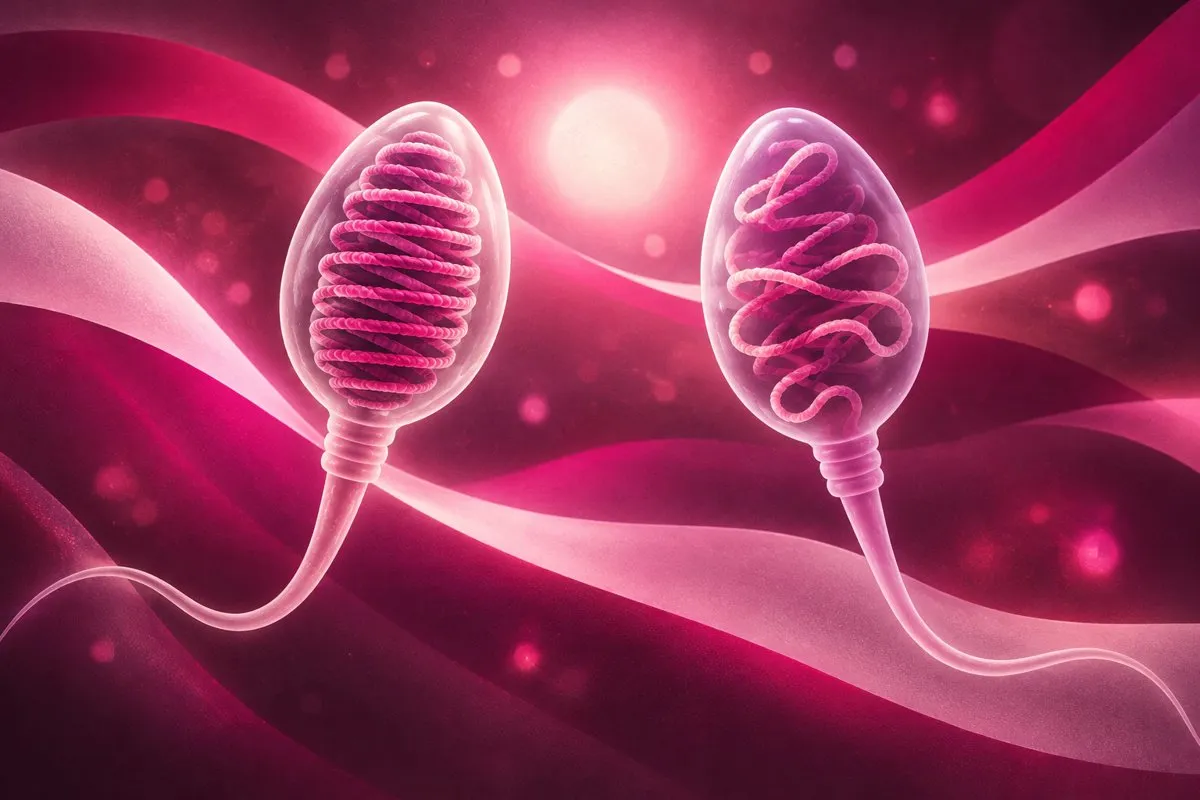
Think of sperm DNA as a very long thread that has to be wound into a tiny, hard-packed spool before the sperm can travel and deliver it. Two things can go wrong:
- The thread breaks. That is DNA fragmentation, measured as DFI. Much of it is linked to oxidative stress in the testes and the tract the sperm travel through.
- The spool is never wound tight. That is high DNA stainability, measured as HDS. During the last stage of sperm production, the proteins that hold DNA loosely (histones) are supposed to be swapped for much smaller proteins called protamines, which lock the DNA into a dense, protected package. HDS sperm did not finish that swap.
When researchers sorted HDS sperm out of samples and examined them directly, those cells had rounder heads than normal sperm and did not carry DNA strand breaks (Jerre et al., 2019). That is the practical point: a man can have a reassuring DFI and a high HDS, or the reverse. If you only read one line of the report, you only know about one of the two problems. For the DFI side of the story, see our guide to sperm DNA fragmentation when the semen analysis looks normal.
Does HDS go up or down with age?
Down, which surprises most people. DFI rises with age; HDS falls. Three large datasets agree:
- In 25,445 men tested at fertility clinics, average HDS fell steadily from 12.2% in men aged 20 to 25 to 7.9% in men aged 60 to 65, while DFI climbed across the same range (Evenson et al., 2020).
- In 16,945 samples from a large US fertility network, HDS was highest in men under 30 and decreased across every older age group (Vaughan et al., 2020).
- In 18,441 samples from Peking University Third Hospital, HDS decreased consistently after age 30, and men 40 and older had lower HDS than younger men (Gao et al., 2021).
So "he's young, his sperm DNA is probably fine" is only half true. Younger men are less likely to have high fragmentation but are, on average, more likely to have high HDS. The same studies stress that the spread at every age is wide, so age is never a substitute for the actual result.
Does a high HDS affect fertilization, IVF or ICSI?
The evidence is smaller than the evidence for DFI, but it points in a consistent direction, and the treatment type matters.
Conventional IVF. The reference lab that runs the SCSA states that samples with HDS above 15% may have lower fertilization rates with conventional IVF, but not with ICSI (SCSA Diagnostics). That fits the biology: in a dish, sperm compete to bind and enter the egg, and mature sperm tend to win.
ICSI and early miscarriage. A Swedish study of 1,602 IVF and ICSI pregnancies found that HDS above 15% was linked to a modestly higher risk of miscarriage before 12 weeks. Across all treatments the odds were about 1.4 times higher, and when the two methods were analysed separately, the increase was significant after ICSI but not after conventional IVF (Jerre et al., 2019). In absolute terms the authors describe it as roughly a 5% increase in early miscarriage risk with ICSI. Their explanation: ICSI skips the competition, so an embryologist can inject an immature sperm that looks normal under the microscope.
IUI. In a study of couples having intrauterine insemination, 19 of 95 couples delivered when DFI was under 27% and HDS was under 10%, compared with 1 of 36 couples when either number was above those cut-offs (Bungum et al., 2004). HDS on its own fell just short of statistical significance in that study; the two numbers together sorted couples far better than either alone.
Trying naturally. In an earlier SCSA study of couples conceiving without treatment, those who conceived within three months had an average HDS of about 9%, while couples not pregnant after a year averaged about 15% (Evenson et al., 1999, as summarized in Vaughan et al., 2020).
Two honest caveats. First, these are population associations, not a prediction for any one couple; plenty of pregnancies happen with an elevated HDS. Second, much of the SCSA research involves the assay's developer, Donald Evenson, who is president of SCSA Diagnostics and discloses it in these papers. The Swedish group and other independent teams have reported similar patterns, but the HDS literature is still thinner than the DFI literature.
What counts as a high HDS result?
There is no single agreed cut-off. Published studies have used 10% (the IUI study above), 15% (the miscarriage study and the reference lab's own guidance), and some review tables list 20% to 25% (Esteves et al., 2021). One clinical group described "defective condensation" only above 25% (Menezo et al., 2014). Use the reference range printed on your own report, and treat a value near any of these lines as a reason for a conversation, not a verdict.
One useful difference from DFI: in a group of 503 men retested over time, HDS did not change meaningfully within six months (Menezo et al., 2014). DFI tends to bounce more from test to test, which is why a borderline DFI is often worth repeating before a big decision.
Can antioxidants make HDS worse?
They can, and this is the part of the research most supplement advice leaves out. The protamine "lock" that packs sperm DNA tight depends on chemical bridges that need a small amount of oxidation to form. In one French clinical series, three months of high-dose antioxidant vitamins (C, E, A with selenium) lowered DNA fragmentation but raised HDS by about the same amount (Menezo et al., 2007, reviewed in Menezo et al., 2014). The authors, including the SCSA's developer, warn that antioxidant vitamins "are often given haphazardly; they are not very efficient and potentially detrimental," and that the sperm nucleus should be analysed before any such treatment.
That is our hot take, and it runs against a lot of fertility marketing: more antioxidants is not automatically better for sperm. A man with high fragmentation and low HDS, a man with normal fragmentation and high HDS, and a man with both are three different situations. A one-size "male fertility stack" ignores that, which is exactly why we want both numbers before anyone builds a plan. For what we do recommend reviewing, see our guide to fertility supplements for men, and run any change past your urologist or prescriber.
What should you ask about your HDS result?
- Did my report include HDS, or only DFI? If only DFI, which test method was used?
- Which HDS cut-off does this lab use, and where does my number sit against it?
- If HDS is high, does that change the case for conventional IVF versus ICSI, or how sperm are selected for ICSI?
- If we have had an early miscarriage after ICSI, has anyone looked at HDS alongside DFI?
- Was the sample collected within the lab's abstinence window and analysed fresh or frozen as the lab requires?
- Is anything I am taking, including high-dose antioxidants, worth reviewing before the next test?
For the wider context of male testing, our male factor fertility workup guide covers where DNA testing fits next to hormones, imaging and a standard semen analysis.
Where can Long Island couples get both numbers reviewed?
At our Huntington office we now order advanced sperm DNA testing that reports both DFI and HDS, because the second number so often explains what the first one doesn't: fertilization that was lower than expected, embryos that stalled, or a loss after ICSI with an otherwise reassuring workup. We read the report alongside both partners' history and labs, and the treatment decisions themselves stay with your reproductive endocrinologist or urologist. Couples come to us from across Nassau and Suffolk County for exactly this kind of review.
Learn more about our male factor fertility support on Long Island, or schedule a free 10-minute call to see whether testing makes sense for you.
East to West Fertility is a metabolic and immune-focused fertility clinic in Huntington, Long Island, serving patients across Long Island, NYC, and beyond. Learn more about our Metabolic & Immune Fertility Evaluation or call 631-416-4940.
This article is for education and is not medical advice. It does not interpret any individual test result. Decisions about IVF or ICSI, medications and supplements belong with your reproductive endocrinologist, urologist or prescriber.
References
- Jerre E, Bungum M, Evenson D, Giwercman A. "Sperm chromatin structure assay high DNA stainability sperm as a marker of early miscarriage after intracytoplasmic sperm injection." Fertility and Sterility, 2019;112(1):46-53. doi:10.1016/j.fertnstert.2019.03.013
- Evenson DP, Djira G, Kasperson K, Christianson J. "Relationships between the age of 25,445 men attending infertility clinics and sperm chromatin structure assay (SCSA) defined sperm DNA and chromatin integrity." Fertility and Sterility, 2020;114(2):311-320. doi:10.1016/j.fertnstert.2020.03.028
- Vaughan DA, Tirado E, Garcia D, Datta V, Sakkas D. "DNA fragmentation of sperm: a radical examination of the contribution of oxidative stress and age in 16 945 semen samples." Human Reproduction, 2020;35(10):2188-2196. doi:10.1093/humrep/deaa159
- Gao J, Yuan R, Yang S, et al. "Age-related changes in human conventional semen parameters and sperm chromatin structure assay-defined sperm DNA/chromatin integrity." Reproductive BioMedicine Online, 2021. doi:10.1016/j.rbmo.2021.02.006
- Bungum M, Humaidan P, Spano M, Jepson K, Bungum L, Giwercman A. "The predictive value of sperm chromatin structure assay (SCSA) parameters for the outcome of intrauterine insemination, IVF and ICSI." Human Reproduction, 2004;19(6):1401-1408. doi:10.1093/humrep/deh280
- Esteves SC, Zini A, Coward RM, et al. "Sperm DNA fragmentation testing: Summary evidence and clinical practice recommendations." Andrologia, 2021;53(2):e13874. doi:10.1111/and.13874
- Menezo Y, Evenson D, Cohen M, Dale B. "Effect of antioxidants on sperm genetic damage." In: Baldi E, Muratori M, eds. Genetic Damage in Human Spermatozoa. Advances in Experimental Medicine and Biology 791. Springer, 2014. doi:10.1007/978-1-4614-7783-9_11
- Menezo YJ, Hazout A, Panteix G, et al. "Antioxidants to reduce sperm DNA fragmentation: an unexpected adverse effect." Reproductive BioMedicine Online, 2007;14(4):418-421.
- SCSA Diagnostics. "Frequently asked questions" (clinic information). scsadiagnostics.com/test/faqs, accessed November 2026.