Does Acupuncture Improve IVF Outcomes, or Just Placebo?
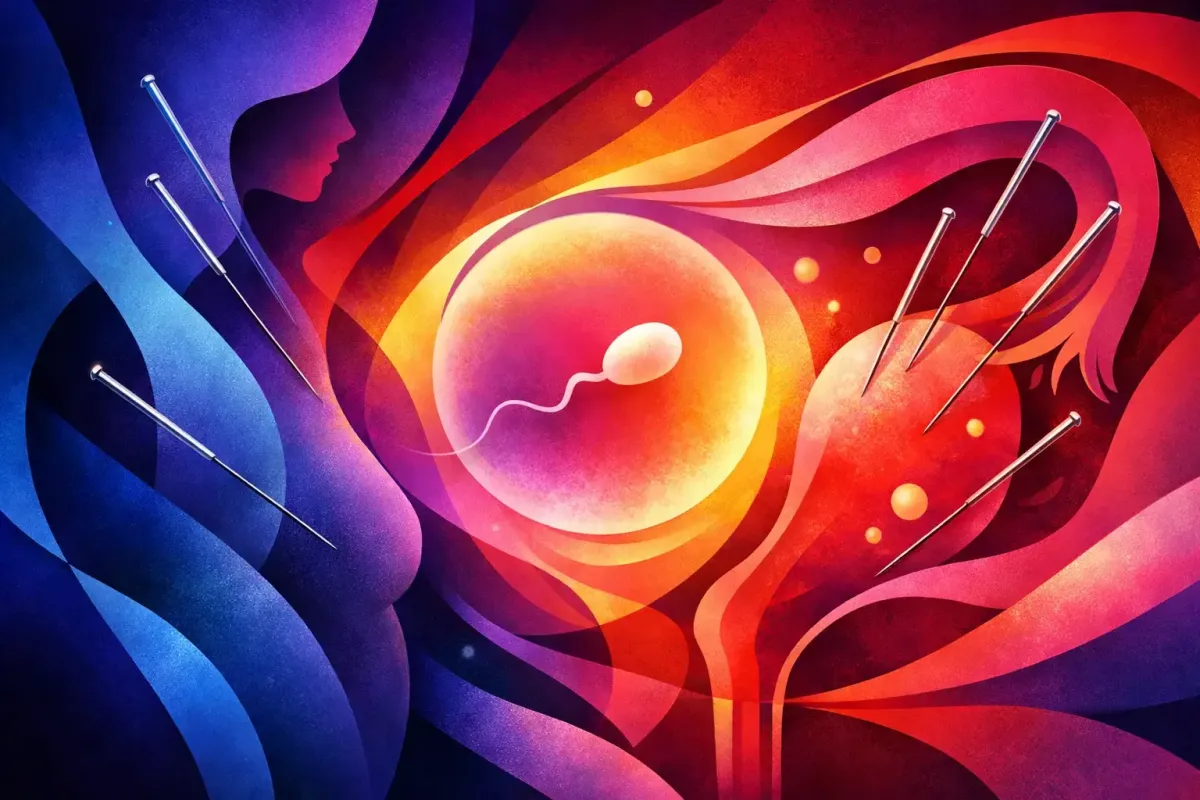
Does acupuncture actually improve IVF outcomes, or is it just placebo?
For the average IVF patient, large sham-controlled trials generally don't show a significant difference in live birth rates — so acupuncture isn't a blanket boost for everyone. But specific subgroups (high stress, thin or slow-responding lining, repeated implantation failure) have shown measurable benefit in some studies, so the honest answer depends on which category you fall into.
The Question You’re Really Asking When You Ask About Acupuncture and IVF
If you are reading this, you are probably somewhere in an IVF cycle, thinking about one, or recovering from a cycle that did not end the way you hoped. You have heard that “acupuncture helps IVF,” and now you are asking a very reasonable, very high‑stress question:
“Does acupuncture actually improve IVF success rates, or is it just a placebo that gives me false hope?”
Patients in our Huntington, Long Island clinic ask this all the time. Underneath that question are a few deeper ones:
“Am I wasting precious time and money on something that does not move the needle?”
“If it might help, how exactly does it help? What is the microscopic ‘why’?”
“How do I integrate acupuncture safely with my IVF protocol so I am not working against what my reproductive endocrinologist is doing?”
This article will not sell you a miracle. It will walk you through what the data shows, what we know about the biology, how we think about this inside our Mitochondrial‑Based Fertility Care Model, and how we guide real patients here on Long Island who are trying to make calm decisions in the middle of a very emotional process.
What the Research Actually Shows About Acupuncture and IVF
Early small studies suggested a benefit
Some of the earliest randomized controlled trials (RCTs) on acupuncture and IVF looked promising. In several small studies, women who received acupuncture around the time of embryo transfer had higher clinical pregnancy rates than those who had no acupuncture at all.
Those early papers sparked headlines and a wave of “IVF acupuncture” centers. But there were issues:
Sample sizes were small.
Control groups often received no intervention rather than sham acupuncture.
Protocols varied widely (different points, timing, and number of sessions).
So they raised a good question but did not definitively answer it.
Larger, better‑designed trials show mixed results
As the field matured, larger and more rigorous trials were done. These studies compared:
“True” acupuncture (points chosen according to Traditional Chinese Medicine and sometimes attached to mild electrical stimulation)
vs. “sham” acupuncture (superficial needling, non‑acupuncture points, or non‑penetrating needles)
When you compare acupuncture to nothing, you often see a benefit. When you compare it to a sham that controls for expectation, attention, and lying quietly in a room, the picture becomes mixed:
Several large multi‑center RCTs have found no significant difference in live birth rates between true and sham acupuncture groups in unselected IVF populations.
Some trials in specific subgroups (for example, women with repeated implantation failure or poor endometrial receptivity) have shown improvements in clinical pregnancy rates and endometrial blood‑flow indices with acupuncture‑based protocols.
In other words, when you include everyone, acupuncture does not look like a magic switch that dramatically raises IVF success rates across the board. But specific patients, with specific problems, may benefit measurably in specific ways.
Where acupuncture may matter most: high‑stress and “hard‑case” IVF cycles
Several patterns show up repeatedly in the literature and in clinical practice:
Women with very high perceived stress often report better sleep, lower anxiety, and greater treatment tolerance when they receive acupuncture through IVF cycles.
Patients with evidence of impaired pelvic or uterine blood flow (abnormal Doppler indices, thin lining that is slow to respond) sometimes show improvements in endometrial thickness and blood‑flow parameters after structured acupuncture courses.
Those with repeated implantation failure or complex metabolic backgrounds (PCOS, insulin resistance, autoimmune or inflammatory patterns) are the groups most often studied in “adjunct acupuncture” trials, with some showing benefit.
So the honest answer is this: We go deeper into this in acupuncture after failed IVF.
Acupuncture is not a guaranteed IVF “booster,” but it is more than a sugar pill. It is a body‑level intervention that seems to matter most when we use it strategically to improve a specific biological bottleneck.
Beyond Placebo: How Acupuncture Could Biologically Influence IVF Outcomes
Mitochondria: the tiny power plants inside your eggs and uterus
At East to West Fertility, we look at this question through our Mitochondrial‑Based Fertility Care Model. Mitochondria are the tiny structures inside your cells that produce ATP, the energy currency your body uses for almost everything. In fertility, they matter because:
Your oocytes (eggs) are among the most mitochondria‑dense cells in the body. They need a steady supply of ATP for chromosome alignment, spindle formation, and the early cell divisions after fertilization.
Your endometrium (uterine lining) and early placenta rely on mitochondrial ATP to grow, remodel blood vessels, and support implantation.
When mitochondria are stressed by poor blood flow, low oxygen, oxidative stress, inflammation, or metabolic disease, ATP production drops and error rates rise.
In Western terms, mitochondria sit at the intersection of metabolism, inflammation, and reproductive function. In TCM terms, this overlaps with concepts of Kidney Qi and Yang, Liver Blood, and “damp‑heat” or “blood stasis” obstructing proper nourishment of the uterus (Bao Gong).
Acupuncture does not “fix” mitochondria directly like a drug aimed at a receptor. But by changing the environment those mitochondria live in, it may improve their ability to produce ATP when your body needs it most.
Pelvic blood flow, oxygen, and endometrial receptivity
Several Doppler ultrasound studies have examined the effect of acupuncture on uterine and ovarian blood flow in women undergoing IVF. The consistent findings include:
Improved uterine artery blood‑flow indices (lower resistance and pulsatility indices), which suggest easier blood flow into the uterine tissue.
In some patients, increases in endometrial thickness and more favorable patterns (triple‑line appearance).
Why does that matter at the cellular level?
Better blood flow means better oxygen and nutrient delivery to the endometrium and ovaries.
Improved oxygen delivery helps mitochondria generate ATP more efficiently, instead of resorting to inefficient, stress‑driven pathways.
Well‑perfused tissue is less likely to be stuck in a chronic low‑grade inflammatory state that undermines implantation.
In TCM language, many IVF patients fit patterns of blood stasis or cold in the uterus – essentially, circulation issues. Acupuncture points on the lower abdomen, legs, and sacral region are chosen to “move blood,” “warm the channels,” and clear stasis. When you translate that into Western physiology, you get targeted modulation of local microcirculation in the pelvis.
Stress hormones, the nervous system, and implantation
IVF is stressful. Cortisol and adrenaline were designed to help you run from danger, not grow an embryo. Chronic activation of the stress response can:
Alter hypothalamic–pituitary–ovarian (HPO) axis signaling
Shift blood flow away from the reproductive organs toward muscles
Increase inflammatory mediators that may interfere with implantation
Acupuncture has been shown in multiple settings to influence the autonomic nervous system, shifting people toward a more parasympathetic (“rest, digest, repair”) state. Measured effects include reductions in heart rate, changes in heart‑rate variability, and modest reductions in perceived stress and salivary cortisol.
At a microscopic level, a calmer nervous system and lower stress hormone signaling create a more stable environment for:
Granulosa and theca cells in your follicles to respond to stimulation medications in a predictable way
Endometrial cells to synchronize their receptivity window with the embryo’s development
Immune cells in the uterine lining to balance defense and tolerance during implantation
In TCM, this aligns with smoothing Liver Qi, calming Shen (the spirit), and allowing the body to direct energy inward rather than constantly fighting external “wind” and internal “heat.” On Long Island, that often looks like helping a woman who has been white‑knuckling her way through years of trying to conceive finally exhale on the treatment table.
Our Mitochondrial‑Based Fertility Care Model at East to West Fertility
Mapping your cellular and metabolic terrain
In our Huntington clinic, we do not tack acupuncture onto IVF as an afterthought. We start by mapping your fertility terrain using Western diagnostics and functional markers, which may include:
Ovarian reserve markers (AMH, AFC, FSH, estradiol)
Thyroid function and antibodies
Blood sugar, insulin response, and lipids
Inflammatory and clotting markers where appropriate
Pelvic ultrasound, uterine blood‑flow assessment, and prior IVF cycle data
We are looking for places where mitochondrial function is likely under strain: insulin resistance, chronic inflammation, poor microcirculation, metabolic “clutter” from too many overlapping supplements, or sleep disruption that never lets your cells fully repair.
Bridging Western diagnostics with Eastern pattern differentiation
At the same time, we perform a Traditional Chinese Medicine evaluation that considers:
Pulses, tongue, and temperature patterns
Menstrual history (flow, clots, pain, timing, PMS)
Digestive function, sleep quality, and emotional patterns
From a TCM perspective, many IVF patients fall into blended patterns like:
Kidney Yin and Yang deficiency (mitochondrial under‑fueling and under‑warming)
Liver Qi stagnation and blood stasis (stress plus impaired circulation)
Spleen Qi deficiency with dampness (metabolic sluggishness, fluid retention, bloating)
Our Mitochondrial‑Based Fertility Care Model is essentially where those two maps overlap. Western labs show us where ATP production and signaling may be impaired. Eastern patterns show us how that impairment is showing up in your whole‑body system.
How we integrate acupuncture and herbs around IVF cycles
Once we understand your terrain, we design an integrated plan that may include: If that is your situation, this is where we start: IVF / IUI Support.
Pre‑IVF mitochondrial priming (usually 8–12 weeks when possible), focusing on sleep, nutrition, movement, and a simplified, targeted supplement plan rather than a crowded regimen.
Acupuncture sessions 1–2 times per week leading up to stimulation, then at key points:
Before and after egg retrieval (to support ovarian blood flow, recovery, and pain modulation)
Before and after embryo transfer (to support uterine blood flow, endometrial receptivity, and nervous‑system calm)
Individualized herbal formulas when appropriate, with strict coordination with your IVF team and removal of any herbs that could interfere with stimulation medications or very early pregnancy.
Every acupuncture point choice is made with both lenses in mind:
Does this support local pelvic circulation and mitochondrial energy demand during this phase?
Does this address the TCM pattern (for example, warming Yang for someone always cold with painful, clotty periods; or nourishing Yin for someone with very light, short periods and night sweats)?
The goal is not to “fix IVF” with needles. It is to optimize the cellular environment your eggs, uterus, and early embryo experience while your IVF team does the lab‑side work.
Is It “Just Placebo”? What That Actually Means
“Placebo” is often used as a synonym for “fake” or “all in your head.” That is not an accurate description of what is happening in complex procedures like acupuncture.
Placebo effects include:
Your brain’s expectation of benefit
The therapeutic relationship and feeling listened to
The context (lying in a quiet room, focusing on your body)
These factors can change real physiology – heart rate, blood pressure, cortisol, immune signaling. In fertility, those are not trivial.
Sham‑controlled trials suggest that part of acupuncture’s benefit is shared with any careful, hands‑on, calming intervention. But we also see specific, point‑dependent changes in blood‑flow parameters and neurochemical signaling that are unlikely to come from suggestion alone.
So the more precise answer is:
Acupuncture includes both “context effects” (what many people call placebo) and “specific effects” from needling particular points. Both can create a friendlier biologic environment for IVF. Neither guarantees a pregnancy.
Who Might Consider Acupuncture During IVF, and How to Do It Safely
Based on the current evidence and our clinical experience, we tend to discuss acupuncture during IVF with patients who: Related reading: our fertility acupuncture treatment guide.
Feel highly anxious, wired, or exhausted through cycles
Have a history of thin or non‑responsive lining or documented blood‑flow issues
Have had repeated implantation failure despite reasonably good embryos
Carry metabolic or inflammatory burdens (PCOS, insulin resistance, autoimmune markers)
Safe integration means:
Working with a licensed acupuncturist experienced in fertility and IVF coordination
Clear communication between your acupuncturist and reproductive endocrinologist about timing, medications, and any contraindications
Avoiding certain herbs during stimulation and after transfer unless both teams agree on safety
Using acupuncture as an adjunct, not a replacement for medically indicated IVF protocols
What We Tell Patients Here in Huntington, Long Island
When a patient sits across from us in our Huntington office, often after driving in from elsewhere on Long Island or the city, and asks, “Is acupuncture actually going to improve my IVF success rate, or is it just placebo?” this is the answer we give:
Acupuncture is not a magic switch that guarantees a baby. The strongest data we have suggests that for the average IVF patient, it does not dramatically change live birth rates when added on top of a good protocol.
At the same time, acupuncture is not nothing. Used thoughtfully, within a Mitochondrial‑Based Fertility Care Model, it can:
Improve pelvic blood flow and endometrial parameters in some patients
Help regulate the nervous system and stress response during an already demanding process
Support the cellular environment that your eggs and early embryo experience
Give you a structured space to care for your body while your IVF team works on the lab‑side details
For many of our patients here on the North Shore, the decision is not “acupuncture or IVF.” It is whether to pair a technologically sophisticated IVF protocol with an equally thoughtful, physiology‑focused support system that respects both Western data and Eastern wisdom.
Only you, together with your medical team, can decide if acupuncture belongs in your specific plan. Our role is to make sure that if you choose it, you are choosing it for clear, biologically grounded reasons – not out of fear, not out of false promises, but out of an informed desire to give your cells, your mitochondria, and your future pregnancy the best possible environment to succeed.
This article is for educational purposes only and is not a substitute for personalized medical advice. Always discuss any new treatment, including acupuncture and herbal medicine, with your reproductive endocrinologist and primary healthcare providers.
If you are weighing this evidence while choosing a practice, our guide to reading fertility acupuncture reviews covers what a review can and cannot tell you about clinical reasoning.