How Thyroid Function and the Placenta Affect Each Other
How do thyroid function and the placenta actually affect each other during pregnancy?
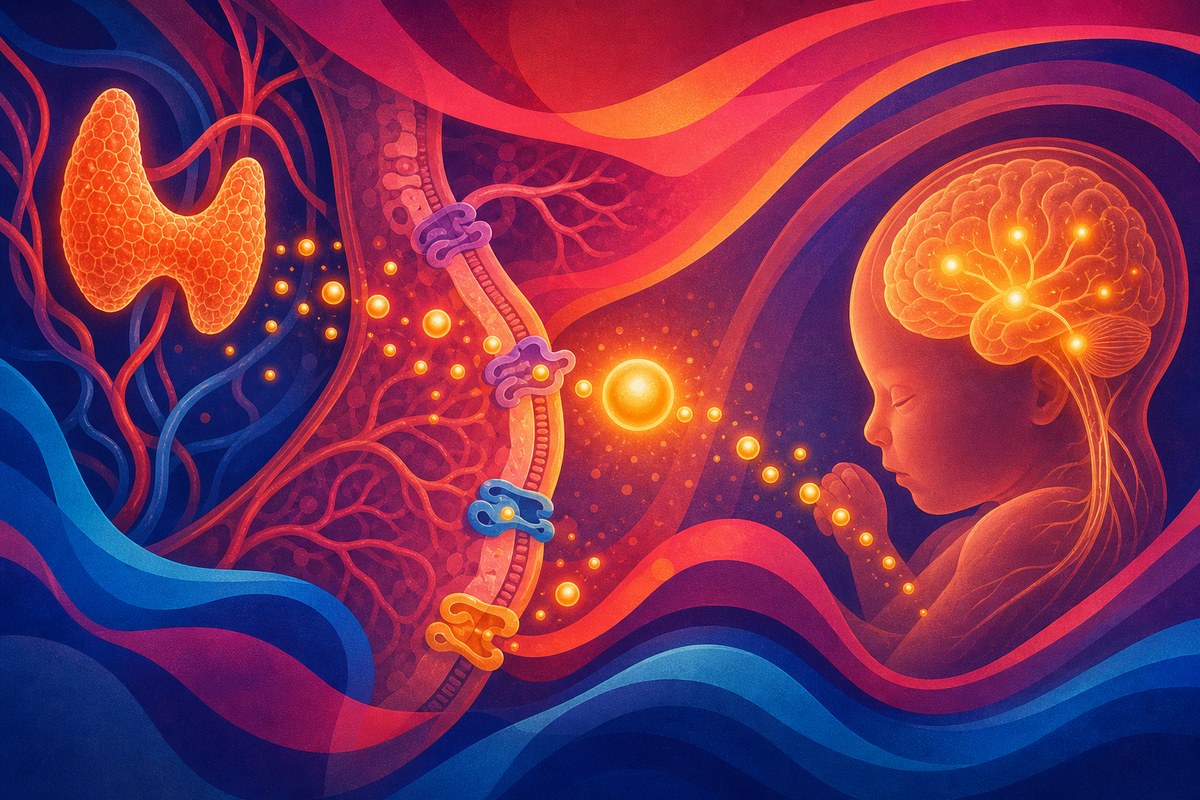
The relationship runs in both directions: the placenta actively regulates exactly how much maternal thyroid hormone reaches the fetus through specialized enzymes and transporters, while pregnancy itself — specifically the hormone hCG — directly stimulates the mother's own thyroid gland in early pregnancy. This isn't a passive relationship where the placenta simply lets thyroid hormone pass through; it's an active, two-way system, and the timing of it matters enormously for fetal brain development specifically.
Why does hCG temporarily boost maternal thyroid function?
Human chorionic gonadotropin (hCG) is structurally similar enough to TSH that it can bind to and activate the same TSH receptor on thyroid gland cells. During the first trimester, when hCG levels peak, a meaningful share of the signal telling the maternal thyroid gland to produce hormone actually comes from hCG rather than TSH itself. This is why free T4 and T3 levels typically rise and TSH is often naturally suppressed during early pregnancy — it's expected physiology, not a sign of thyroid dysfunction. This is also part of why pregnancy-specific TSH reference ranges run lower than standard non-pregnant ranges, particularly in the first trimester; a TSH value that would be flagged as abnormal outside of pregnancy may be entirely normal during it.
hCG has a second, separate thyroid-related role: it directly stimulates the sodium-iodide symporter (NIS) within the placenta, actively promoting iodine transport from the maternal bloodstream to the fetal side. Since thyroid hormone synthesis fundamentally requires iodine, this transport function is a meaningful part of how the fetus gets access to the raw material for its own eventual thyroid hormone production, in addition to receiving maternal thyroid hormone directly.
What does the placenta's deiodinase system actually do?
The placenta isn't simply a passive membrane that thyroid hormone crosses freely — it contains its own set of enzymes, called deiodinases, that actively modify thyroid hormone as it moves through. Placental type 3 deiodinase (D3) is highly expressed and converts T4 into reverse T3, an inactive form, while type 2 deiodinase (D2) can convert T4 into active T3 in specific contexts. This system functions partly as a protective buffer, moderating how much active thyroid hormone reaches fetal circulation rather than allowing an unregulated flow, while D3 also plays a role in recycling iodine back for fetal use as the fetal thyroid gland matures.
Specific membrane transporters, including one called MCT8, are also required to actually move thyroid hormone across placental and later neural cell membranes. A 2025 study in JCI Insight used stem cells derived from a boy with a loss-of-function mutation in MCT8 and found that thyroid hormone delivery into developing neural cells is required for those cells to properly differentiate into neurons. That is laboratory work in a rare genetic condition rather than a study of typical pregnancies, so it explains a mechanism rather than predicting outcomes — but it is a direct demonstration of why the delivery system, and not just the maternal blood level, matters.
Why is the first trimester the critical window?
This is the piece that makes the timing of thyroid health so significant. The fetal thyroid gland doesn't begin trapping iodine until roughly 12 weeks of gestation, doesn't synthesize its own thyroxine until around 14 weeks, and doesn't reach significant hormone secretion until 18 to 20 weeks. For that entire early window — which overlaps directly with the most critical period of early fetal neurogenesis — the fetus is dependent on maternal thyroid hormone crossing the placenta through the transport and deiodinase systems described above.
Low maternal T4 with a normal TSH, called isolated maternal hypothyroxinemia, is more common than most people expect. Reported prevalence varies widely with the cutoff a study uses, from roughly 1% to 24%, with most studies landing around 8 to 10% of pregnancies. It has been associated in observational research with differences in offspring cerebral cortex volume and later cognitive development, though association is not the same as proof of cause, and treatment trials have not consistently shown benefit. Our piece on thyroid issues and infertility covers the preconception testing gaps relevant to catching this before pregnancy even begins.
Even in cases of congenital fetal hypothyroidism, where the fetal thyroid gland itself isn't functioning, maternally-derived T4 crossing the placenta appears to provide meaningful protection for cognitive development — cord blood T4 levels in these cases can reach a substantial fraction of normal values, entirely from maternal and placental transfer. This illustrates just how much the maternal-placental thyroid hormone supply matters, independent of whether the fetal thyroid gland is working on its own yet.
How does this connect to the rest of placental health?
Thyroid function is one input into placental development, not the only one. The same early weeks in which the placenta is establishing its blood supply are also shaped by insulin signaling, inflammation, and vascular health, which is why thyroid findings often show up alongside metabolic ones rather than in isolation. Our piece on how insulin resistance and PCOS affect the placenta covers the metabolic side of that same window.
What does this mean practically?
Because the fetus depends on maternal and placental thyroid hormone supply during exactly the window when neurogenesis is most active — often before pregnancy is even confirmed, let alone before thyroid levels would typically be checked — this is a strong, mechanistic argument for addressing thyroid health before conception rather than waiting for a first-trimester lab panel. At our Huntington office, our Metabolic & Immune Fertility Evaluation includes thyroid function as one of the core areas we investigate during preconception planning. It's also worth knowing that thyroid antibodies, particularly TPO antibodies, can affect this system even when TSH itself looks normal, which is covered in more depth in our piece linked above.
What this does not mean is that every borderline thyroid result requires medication. Whether to treat subclinical hypothyroidism or isolated low T4 in pregnancy is genuinely debated, and that decision belongs with your endocrinologist or OB-GYN. The argument here is for knowing your numbers early, not for assuming they need correcting.
The Bottom Line
The placenta and maternal thyroid function are in active, continuous dialogue throughout pregnancy — hCG temporarily boosts maternal thyroid output early on, while placental deiodinases and transporters carefully regulate exactly how much and what form of thyroid hormone reaches the fetus. Because the fetal thyroid isn't functional until well into the first trimester, the maternal-placental supply is the main source of thyroid hormone during a critical window for brain development, which is a strong reason to look at thyroid health proactively rather than reactively. Here in Huntington, thyroid function is one of the core metabolic factors we investigate as part of preconception planning, precisely because of how early this window actually begins. Our piece on what you can still control with a high-risk pregnancy covers thyroid monitoring alongside other factors worth tracking once pregnancy begins.
This article is for general educational purposes and isn't a substitute for individualized guidance from your OB-GYN, endocrinologist, or fertility provider. Thyroid testing and treatment decisions during preconception or pregnancy should be made directly with your care team.
East to West Fertility is a metabolic and immune-focused fertility clinic in Huntington, Long Island, serving patients across Long Island, NYC, and beyond. Learn more about our Metabolic & Immune Fertility Evaluation or call 631-416-4940.
References:
- "Influence of maternal thyroid hormones during gestation on fetal brain development." PMC4819012.
- "Hypothyroidism in pregnancy." Indian Journal of Endocrinology and Metabolism. PMC3354841.
- "Delivery of maternal thyroid hormones to the fetus." Best Practice & Research Clinical Endocrinology & Metabolism.
- "Thyroid hormone promotes fetal neurogenesis." JCI Insight, 2025 (jci.insight.194445).
- "Obstetric and offspring outcomes in isolated maternal hypothyroxinaemia: a systematic review and meta-analysis." PMC10185648.
- "Thyroid Hormones: Pregnancy and Fetal Development." Colorado State University.